On a Saturday in late fall we held a follow up to our modeling workshop. One of the participants brought a colleague along with her. During one of our discussions she mentioned that she had been having students do a daily recap of the previous lesson. I thought the idea was brilliant and so I started having my IB chemistry HL class do it. I recently expanded the recaps to my chemistry classes. There are multiple benefits to doing this and I wanted to put them together and encourage teachers to try using this tool in your own classes.
1. Students listen differently to their peers.
When I talk, the students trust me to say “correct” things about what we are learning. When a student is explaining that trust is not there. This causes students to listen differently with a more critical approach. If a student says anything that is slightly wrong or even if the letters they write are slightly misshapen they notice immediately. This type of critical listening is very valuable for student learning. They’re connecting topics and ideas and evaluating whether they fit or don’t. They should do this when I speak. Pointing out to them this discrepancy can be helpful for pushing their learning to a higher level.
2. What I think students know and what they actually know are frequently different.
Being able to see what a student took from your lesson is helpful. Sometimes teachers get wrapped up in the world of “But I told them once, they should understand it!” Spending time listening to students every hour to start things off builds a much better perspective of what they are learning instead of what you are teaching.
3. More student voice
At the start of this year I was nervous to call on quiet students during discussion. In the past students had given feedback that they would participate but that talking in front of everyone terrified them. It was a mistake to listen to that feedback. It created an unhealthy class dynamic where students sought out correct answers instead of focusing on what they currently understood. It pushed the idea that there are smart chemistry students and dumb ones. It was also racist and sexist in that some races and gender combinations were heard from more than others.
However, this is a concern for students and it needs to be handled well to be successful. When students say “I don’t know” during discussion, you’ll want to emphasize that the solution to not knowing something begins by starting with what you do know and building connections to those ideas. Frequently teachers undermine this by making statements about “being happy about mistakes” or “mistakes are opportunities to learn”. Instead it’s important to show students how to cycle through learning something new by seeking out a starting point of what a student does know and how to evaluate possible explanations, logic and evidence to build towards the new learning objective.
It is important not just to say this, but to keep a healthy approach as students do the recaps. Many are nervous but I see a lot of that disappear as I point out the good points of their recaps. As they realize the intentions of finding out what they know they produce more honest recaps. I would also like to say that I am frequently surprised at students that I would expect to struggle with a recap because they are quiet. These students are perfectly capable of doing an excellent recap and hearing from them improves their inclusion in the classroom.
4. Spaced practice
Spaced practice is the opposite of cramming. In cramming a set of ideas is repeated until familiarity sets in. In spaced practice the learning is split up so that forgetting occurs between the intervals of learning. The research strongly supports spacing practice. By allowing students to forget and then re-learn the material the impact on the brain is substantial. Doing a daily recap allows students to forget part of the material and then relearn it the next day. This leads to less forgetting and also better understanding.
5. Reflection
Students know that the next lesson will involve a randomly selected student giving a recap. When two or three minutes are left in a lesson the students can then reflect on what they learned and what they would present if they were to be selected the next day. This can help them evaluate and organize the learning.
This is a new technique to me but the value is already immense. I have thoughts on how to modify the technique such as having two students selected. One gives the recap and the other supplements additional ideas. The time varies because most students will talk for 5-6 minutes and not realize they had talked so much. Some teachers might elect to tell students the day before who will speak (which could be an issue if there is an absence). I roll dice to determine who will speak and they get no prep time to pull things together. Currently students can bring notes with them but they are discouraged from using them and not allowed to just write what their notes say. If they get stuck they are encouraged to ask questions to other students.
I had a moment several years ago where I was reading about a terrorist attack where someone had shot and killed people and based on the race of the shooter media had begun reporting about mental illness. Reading the response immediately brought to mind that I had done the exact same thing when I was a new teacher at my first teaching job. I had had a white student go on a swearing rampage and storm out of the classroom. I remember thinking that he had lost control of his emotions. Later in the year a black student had a similar although lesser violation. This time I asked two other teachers what I should do in response and they both told me to write a referral. I did and when I talked to the student he literally told me what I was doing was wrong. And his rationale bounced right off of my dense head. No I thought, I can’t be racist I thought. I’m a good person, I’m a teacher. I asked two other teachers. The other student was different because they had a documented issue. I dismissed his comments and followed through. In retrospect, this student was probably used to getting the short end of the stick and this was a common experience for him. And I had no idea until years later that I had been in the wrong.
Since then I’ve been working at trying to make sure that I would not fail another student because of their race and also trying to elevate talented students that get overlooked because of their race. It has been a surprisingly uneven journey were I have learned a lot but often at the expense of my students. When I messed up I would always try to apologize and reflect on what I should have done instead. Here are some lessons that I’ve learned to this point.
1. We often present racism as something that black people need to fix instead of white people. In the above scenario I am the racist. I had no ill intentions and if I could do something to fix what I did I would in a heartbeat. I feel awful about it. But instead of recognizing our own role we tend to shift race onto minorities and onto students instead of white people. I was confusing not being a bigot with being unable to be racist. And that confusion is common and it is very counter productive. I was the one with the problem and I missed that because of my ignorance.
2. Everyone is racist. It’s not a binary system where you’re racist or you are not racist. It’s a spectrum like autism and everyone is somewhere on the spectrum. One of our biggest problems is that people confuse racism with bigotry. Being a bigot means that you don’t like a person because of their identity. Being racist means that you contribute to the construction of racial structures where people of a minority group become linked with no evidence or rationale. This happens frequently. We all do this. When a student is loud they are being disruptive but when a black student is loud they are being loud because they are black. Teachers tend to notice the black students being loud even if the decibel levels are comparable.
A racist comment I read once was a lady saying that she isn’t racist and she makes sure to teach her children to treat everyone equally. This doesn’t come off as racist to many people but it is because what the person is doing is reinforcing the idea that black people are all one group. She’s not telling her kids we treat everyone equally when something arises with white people, only when black people are involved does this phrase manifest. That distinction causes black people to become linked when they are just individual people. The reality is the more you ignore race the larger your racism impact becomes for most people.
3. There are methods to be less racist or more anti-racist. The biggest thing that I’ve learned to do is to always pause. Your brain uses two systems to work, one is automatic and the other involves thinking. If you have positive intentions but negative impacts, it’s frequently due to automation. So when you are about to discipline a student, you need to pause and determine if this is an automated trained response where you are being unfair or if this is a reasonable course of action. In order for this to work you have to be honest with yourself and for many that is a challenge.
My favorite compliment I ever received was at conferences a parent had come in even though their child was doing very well in the course. She just wanted to let me know that her daughter had told her that in every class she took she always felt like the “muslim girl” but in my class she was just a normal kid. This should be one of our primary goals. Our students are not free in our schools to be themselves. We should be looking for opportunities for our students to be free from their race and this doesn’t come about by ignoring race. This also doesn’t come about by treating racial disparities as a problem for black students and not for white students.
A good way to improve your thinking is to try hard to analyze white people for a length of time. Every time you talk to a white student try and pause and evaluate if you are doing so differently because of their race. Are you asking them a harder question that requires more independence because they are white? Are you asking them about academics or social things instead of athletics because they are white? Were you standing closer in proximity to them because they are white? At first it is very odd, but I think we secretly do this for black students and that differentiation is perceived by the student whether the teacher is aware they are doing it or not. And it makes an impact. If you’re skeptical you can start by taking an IAT here.
Becoming less racist is not something you can accomplish without effort. But if minimal effort is the best you can do, listen to other people who speak honestly about it. If you can find someone to follow on twitter, or read a book about race. Without critically thinking and reflecting you’re unlikely to change enough but do something.
4. We don’t listen well. I had gone to a professional development session. It was for white women to talk about their role in racism under the pretense that white women often escalate tensions as men feel a need to protect them. I didn’t want to intrude on the session so I decided to go, but sit in the back and not comment the entire time. During the session as people offered up ideas and comments one of our black teachers started to talk about our district. My ears perked up. This is exactly what I wanted. I wanted the expertise of someone who lives this every day. We don’t have a lot of black teachers and so not only does she have her own experiences but also a lot of black students confide and trust in her so she is incredibly knowledgeable. And yet the second she finished speaking another teacher said that they disagreed and they felt that we were doing a great job with race. Another teacher confirmed this and I watched the room completely miss what was said. Later I was at a different PD session and a black professor from Michigan State was working with us to help us. A teacher asked the most inane question and he was so patient with her. When she first spoke I felt the urge to chastise the question but instead he listened to her, met her where she was and tried to help her in spite of her question being what I considered to be dismissive of his efforts.
I hear a lot of teachers claim that students play the race card to get out of trouble but the evidence I see would make this incredibly rare. And that doesn’t mean that you won’t be supported by others in your claim it just means that you are likely wrong. As a teacher I watch white students perform infractions constantly and get away with them. I listen as administrators tell me about parents who obstruct discipline for their white children in spite of clear evidence of rule violations. But our perspective is the opposite and that is dangerous. If you don’t know the statistics but assume they benefit black students you are wrong and contributing to a racist narrative.
5. We are too comfortable with our racial disparities. If white students started to achieve less than black students we would work tirelessly to make sure we were being fair. When black students struggle we consider this the norm and make ceremonial efforts at mitigating the damage. Part of this arises because people think that they are special and that others are the problem. But we all share this burden and it’s time we put together a more concerted effort. Psychological evidence shows that teacher expectations have a massive impact on achievement. We know of the study where random students were given a gifted label and then outperformed their peers. We know of the blue eyes, brown eyes study. And yet when we see these same results in our classrooms with consistency we can’t reflect on what we do to contribute to the problem.
One of the solutions is that each teacher needs to think hard and reflect and work on being more anti-racism and less racist. The other is that we need teachers to anticipate that students are going to come with deficits and have a plan to help students achieve even if they start out behind. As a chemistry teacher lots of my black students struggle and there are methods for them to still be successful if I put in the effort to give them opportunities to catch up. But if I give a math pre-test on day 1 to scare struggling students out of the class to make my job easier then that’s not going to happen. If I don’t give students current cognitive research strategies and instead tell them they need to work harder or study more when they’re scrambling to keep up as it is they aren’t going to be successful. It’s not your job to set out a set of parameters that negatively impact one racial group over the other. It’s your job to figure out methodologies that allow students to succeed. And it will take more effort to do that and it is worth the effort to do so. When you tell 9th graders that in order to be a chemistry student you need to have done X by the time you were fourteen years old the students you are most often restricting are black students who may very well be on a path to being a chemist but need more time to get there.
But a huge part of your job that also is important is that we need to not have students going into teaching (or other professions for that manner) without a strong understanding of race and racism. There were people who could have taught me about racism before I failed that student and they didn’t. I think that I would have been receptive to the conversation even if it was critical but I never got the chance and someone else paid the price for that. We need our white students to not leave school thinking that diversity doesn’t apply to them. We had a professional development session once and the speaker asked us to name white people that had been supportive of civil rights for black people. I knew of none and I knew that I was not on a path to be on that list in the future. We teach that white people are the cause of racism but not the solution and shifting that focus goes a long way towards being successful at reducing racism towards our children.
Considerable time and effort are spent evaluating teachers without much to show for it. Rarely does a teacher excel in teaching and credit their evaluation system for helping them to get where they are. Evaluation systems rely on overworked administrators that nearly always end up accomplishing compliance rather than effective feedback, evaluation and improvement. This causes the administrator to rely on a rubric that often is inappropriate. For example, our district uses the same rubric to evaluate my chemistry class as well as physical education, elementary, special education, etc. The systems on these rubrics are most inappropriate because they evaluate the teacher and classroom environment relative to an expectation. The end goal is the initial evaluation.
I teach science using the modeling pedagogy. The big philosophical difference between modeling and traditional teaching is that in traditional teaching the student is explained what the final objective or standard is and then this is repeated with variety as the student approaches that standard. Modeling, in contrast, starts with where the student is. What is the current understanding of this concept and how can this student construct models from their understanding that are revised when the models fail or require change to explain discrepancies. A big flaw in traditional learning is that by focusing on the final product in lieu of the status quo for the student we build concepts with lots of holes and misconceptions. In a constructivist approach students are more likely to identify and deconstruct these misconceptions.
How can we shift teaching evaluations from a traditional model to a constructivist approach? We need much more contact time with teachers. Administrators do not have the capability to accomplish this. I have had some of the most talented administrators that I could have ever expected and yet I rarely see anything of value from my evaluations. Instead we should create positions dedicated to evaluation and observation only. If a position was only spent meeting with teachers on prep periods, setting goals with teachers, observing teachers, giving feedback to teachers and connecting teachers the evaluation system improves dramatically. This changes the evaluations from punitive to feedback and change focus from busy work and compliance to improvement and growth.
Teaching is very isolating. Teachers are alone in their classrooms for the majority of their career. Even when teachers meet with other teachers and do professional development it is very easy to continue doing the same things. But having a quality teacher working with you is a tremendous advantage. An employee that does observations full time will get to experience the strengths of a school and will be able to connect teachers based on strengths, weaknesses and goals. If a teacher wants to work on assessment, the evaluator will know who does assessment well and can facilitate connecting them. The larger amount of contact time also allows the evaluator to observe the teachers more frequently, more informally and also work on planning. You would get better consistency by having fewer people doing evaluations and since they would spend more time with each teacher.
This would also open up some time for overworked administrators to spend less time fulfilling compliance requirements and instead have positive impacts on their staff and students. Currently most administrators can spend their entire day answering emails, attending meetings and dealing with disciplinary infractions. By opening up their time they would be able to work on mentoring programs, developing professional development, being more visible in the school and whatever creative programs they desire to implement.
I hate grading. Grading takes so long and marking wrong answers for hours on end after spending so much effort on teaching is an emotional drag. Grading isn’t just obnoxious because it is redundant, length and often mindless. For high school teachers it can often be used as a tool to shame students, to make them feel bad about themselves and that blame is tough to share and unhealthy to deflect to students and their parents.
I was listening to a podcast about how we do not remember our memories correctly. We replace our memories with what we currently believe as often as possible because of how brain storage works. If you currently are aligned heavily with a set of political ideologies, you are likely to shift your memories towards those same ideologies. But I couldn’t help listening to this podcast to think about how grading affects teachers negatively. When teachers grade they see the correct answer 170 times. They even see the wrong answers so frequently that they will often tell the next group in advance of what mistakes they will make. So when a student repeats a mistake it can produce an unhealthy response. We think of students as lazy or that they don’t care. This happens especially when teachers are put under external pressure from administrators, parents and even the students themselves. And as we continue this year after year we eventually reach a point where it is beyond the teacher to remember what it was ever like to learn the material for the first time. We shift our memories to think of our subject matter is being so clear and simple that we disconnect from reality.
About six years ago I was going through my files and I found a set of exams from when I was in college studying chemistry. I looked them over and a multiple-choice question from my advanced thermochemistry class caught my eye. I read a question and saw that I had gotten it wrong. It was about entropy, enthalpy and spontaneity and I got really upset at myself for getting it incorrect. In fact, I remember thinking how furious I would have been had one of my students, even a struggling student, if they had made the same mistake I had made in my third year of college. I had taken high school chemistry, AP chemistry and was over 30 credits of chemistry in to my degree when I made that mistake.
I think that moment has prevented a lot of negativity towards my own students as I now can remember with a little bit of evidence that sometimes students know something but struggle with the mechanics of the question, sometimes new information makes us uncertain and sometimes it just takes time to understand a concept. When students get questions wrong I no longer take it personally. I will never get angry at a student for being wrong or needing more time to understanding something. If a student or parent tries to push an unhealthy pressure on me I feel comfortable deflecting that pressure away and not engaging with them. And I believe I just found the perfect grading system to make this all work.
I have now been using standards based grading assessments for the past three years in my chemistry classes. This has been a minor change as it is really just chopping up the test into sections that focus on 6-10 concepts from a unit (examples are on my chem website). I liked the organization and felt that it improved feedback to students and parents. But in the past two weeks I have started to add one last feature and I think the slight increase in grading is about to be overwhelmed by the reduction in mental health stress in grading. Students will now be able to reassess on standards.
The logistics I am currently planning on using involve having students complete a form for any standard that they wish to reassess that focuses on directing students back to what we learned in class. They can then improve their understanding of the topic and reassess. Reassessments will happen once per week on a rotating after school and lunch schedule that so far has been very reasonable to execute. The following year I will join with the teacher next door to me so that each of us is only responsible for every other week to supervise students reassessing.
Grading still is not fun, but the last two tests that I have graded I have felt so much more at ease with student mistakes. It is no longer an omission that will compound as the year progresses, but instead feedback that the student can rectify and incentive for them to reflect on their understanding as well as what they accomplish during class time. It is no longer an indictment of my teaching but instead feedback to me on what went well and what did not. It is no longer a cycle of two week periods where students rush through material, but instead this allows us to slow down when needed without losing content.
Students were taught about light and then asked to write a reflection on what they used to think light was and what they now understand it to be. The three principal lessons used are described below and then student comments in their reflections are used to evaluate the models they develop, the physics struggles and some reflection on what they need to bring with them from previous classes and experiences.
Lesson #1 - Spectral Emission Lines
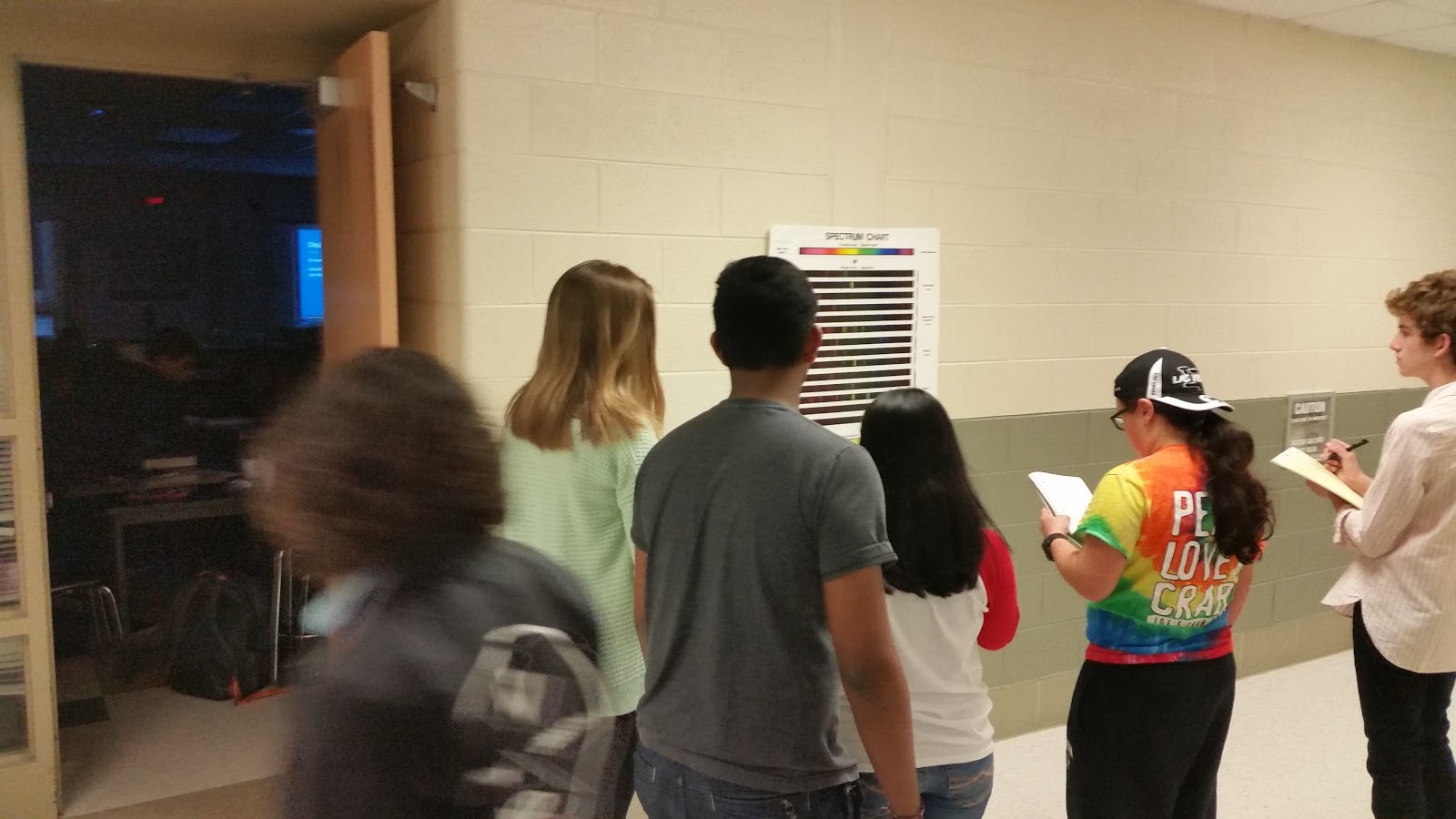
Students observe emission tubes using spectrometers. They attempt to match the spectra they observe with spectra on a poster.
Figure 1: Students working during lesson 1
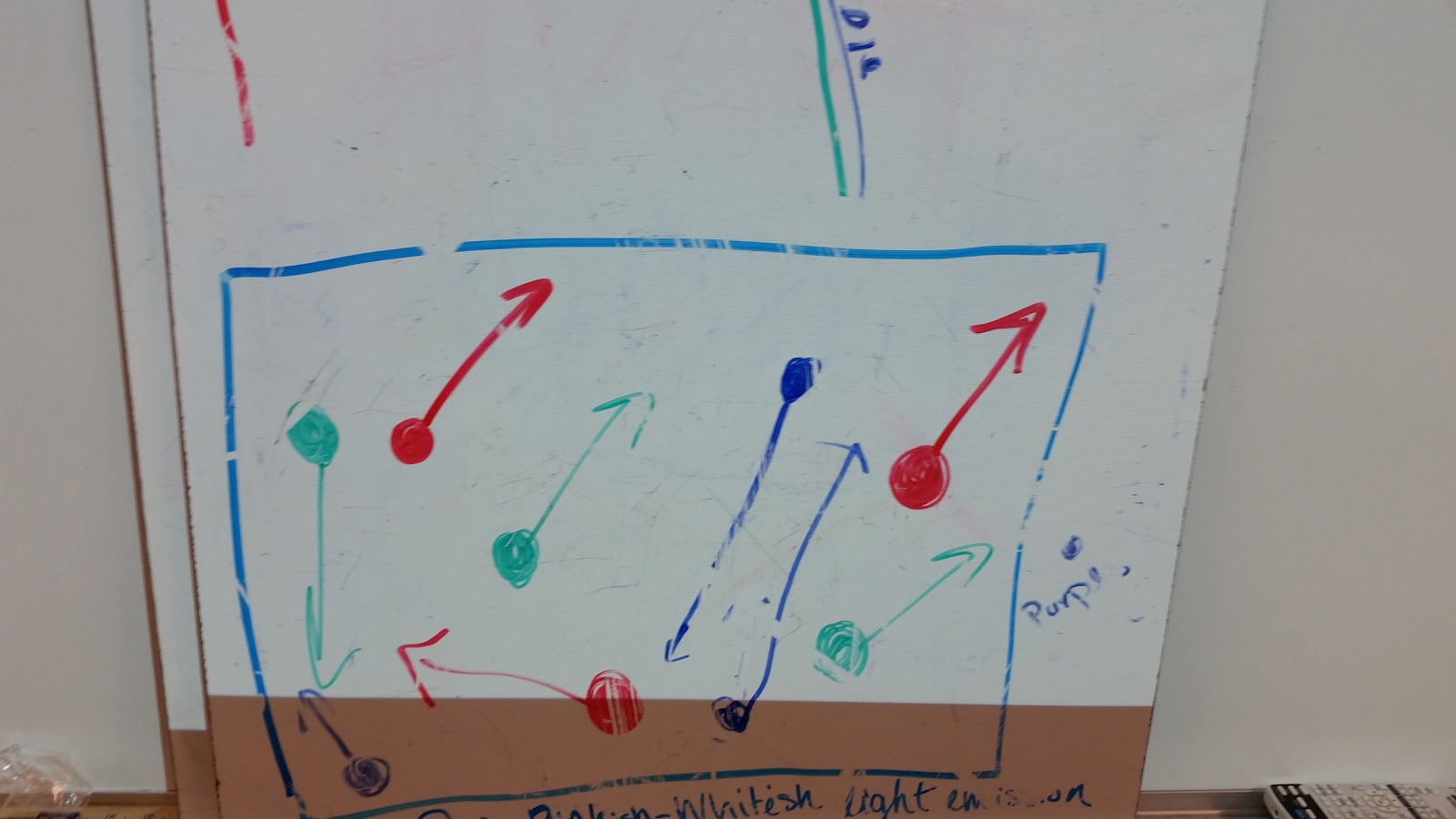
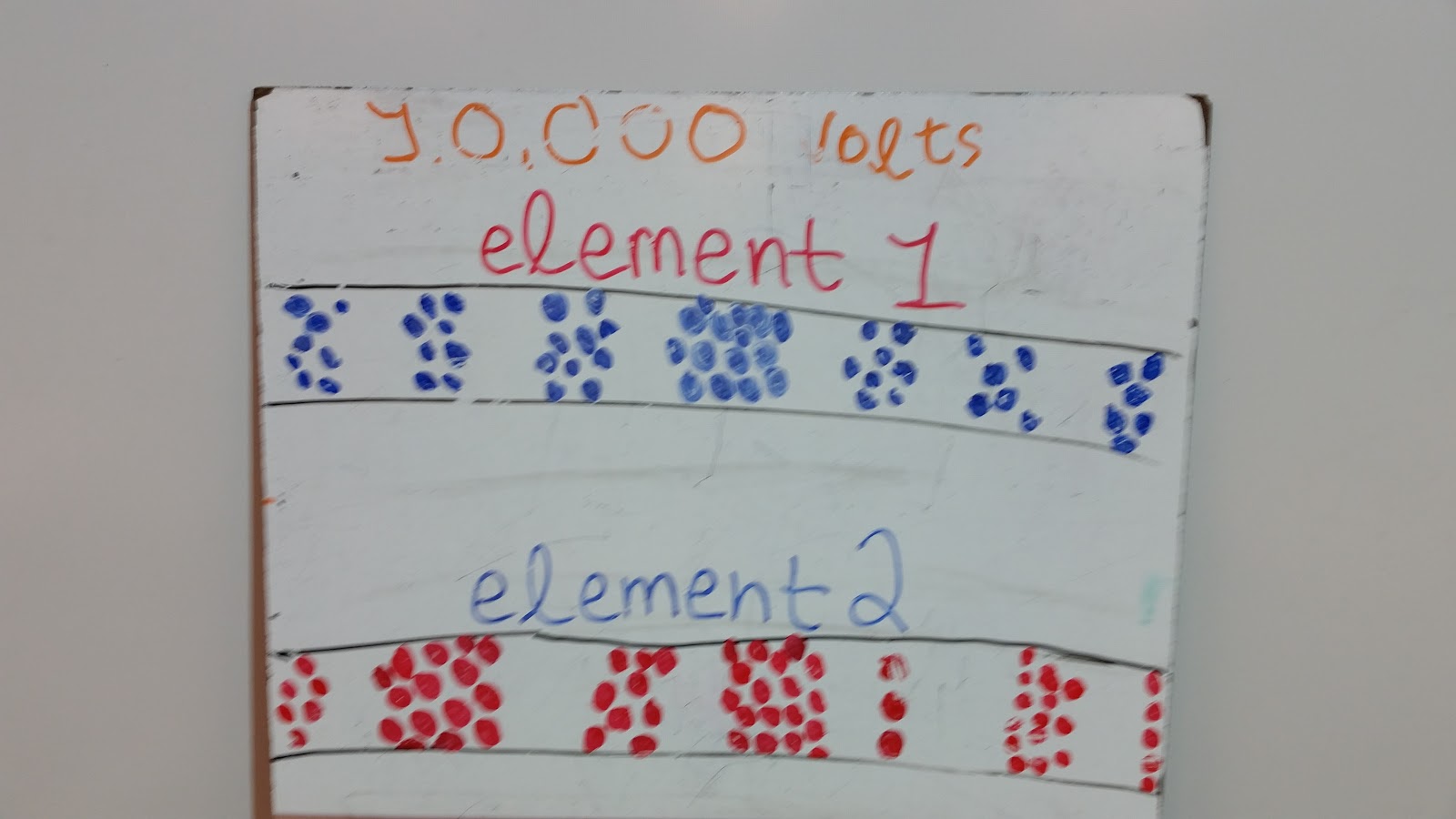
After the students have spent time observing spectra they are asked to complete a whiteboard that shows a particle diagram of what is happening in a H-emission tube at 10,000 V. They are guided with two agreed upon observations, first that multiple colors are emitted and secondly that different elements gave off different sets of colors. With 3 classes completing this task, there were eighteen whiteboards produced. Zero of these boards showed electrons or charged particles. Many showed colorful Hydrogen particles.
Figure 2: Whiteboard of initial student model of light emission
Figure 3: Whiteboard of initial student model of light emission
Figure 4: Whiteboard of initial student model of light emission
Figure 5: Whiteboard of initial student model of light emission
Figure 6: Whiteboard of initial student model of light emission
The initial student models show that the task is very advanced for the students. No boards show electrons in their models. Some students consider the particles themselves to be the color of the light, some show faster particles producing different colors of light and one board (Figure 4) even shows the particles arranging themselves into a wavelength form where the bulk particle arrangement is the difference. None of the students are even close to having a working model of why an element will only emit certain colors and not others.
Lesson #2 - Flame testing
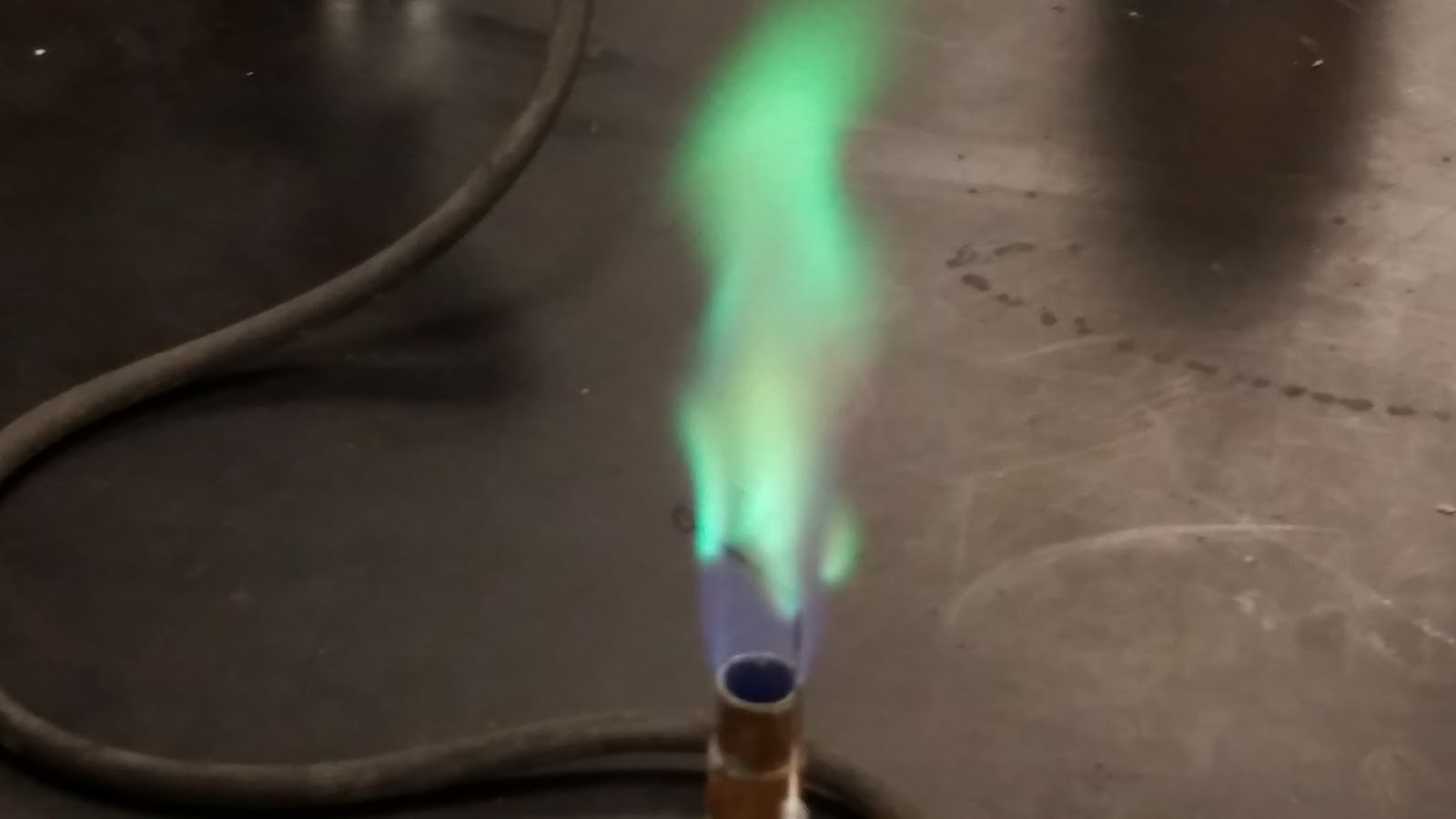
A continuation of the concepts from lesson #1, the students here are tasked with flame testing various salt solutions and then identifying two unknown solutions with food coloring added.
Figure 7: Solutions to be flame tested including unknowns A and B with food dye added
Figure 8: Flame testing CuCl2 and LiCl solutions
The discussion here is kept to a minimum. The key ideas are reinforced that the elements are producing different colors and each element is producing multiple colors of light.
Lesson #3 - Light demonstrations
In lesson #3 we begin with the intention of eventually explaining why a single element will produce multiple colors of light and why the colors vary from element to element. But first we have to improve our working model of what light is and how light interacts with matter. A series of demonstrations and guiding questions are used.
What is light?
It is easy to find a short-answer or definition to this question that avoids the deep thinking needed to really grasp what light is. I begin with a demonstration of a ruler being attracted to a charged pool noodle seen below.
The purpose of this demonstration is not to understand how polarization works, rather it is to introduce the idea of a field. How is that the ruler and the pool noodle can interact without touching? Michael Faraday developed the idea of fields and here we establish that charged particles can interact without touching, at a distance. We use the field idea to describe how these interactions would take place at any given point.
We then immediately move onto a PHET simulation called electric field hockey. The simulation is a game where you try to propel a charged particle into a goal while avoiding obstacles. The simulation allows you to show fields from the charged particles and also how they change as you shake a particle. This disturbance to the electric fields is what light is. This is a very challenging idea so we want to spend some time showing how two charged particles would interact via the field disturbances. If we shake one particle, the electric field is disturbed which would then create a variation in force on other particles. This process is what we call light. The veracity with which you shake the charged particle will impact how much the change in motion the other particles have. Here we set the foundation for frequency and how frequency influences the ability of light to cause greater or lesser impacts.
Now is a good chance to show students an image of light that they would have seen in the past in a textbook. A picture such as Figure 9.
Figure 9: A representation of disturbances in electric and magnetic fields1
Next I like to follow up with a demonstration on the optical activity of corn syrup. This allows me to show the students some evidence of the electric field composition of light. The corn syrup has 4 different groups bonded to carbon atoms that causes a change in the electric fields of light and it affects different colors differently.
This is also a good chance to show the students the difference between a wave pulse and a standing wave as they likely have only seen waves presented as a standing wave up until this point. I get one of the longer slinkies out and have a student hold the other end. I start by setting up a standing wave and then show the students a wave pulse where I just give a brief shake of the slinky and the wave travels down the slinky and back. I try and show how a series of wave pulses causes the standing wave as well. If you get out the slinky it is worth it to go through frequency as the number of shakes per second and how this would translate to light waves (the number of shakes of the charged particle per second) as well as how this impacts the wavelength.
What types of light are there?
There are 7 different types of light (radio, microwave, infrared (IR), visible, ultraviolet (UV), X-rays and gamma rays). I use the PHET simulation of radio waves to show how radio works in their car. For microwaves it can be fun to put ivory soap into a microwave or a candy bar. For IR light some cell phone cameras can detect it (my Samsung 6 works well, iphones do not, older phones usually work) so put a remote control in front of the camera and it will display the infrared light as visible on the camera screen.
For visible light I really like the photoelectric effect demonstration from Flinn Scientific. Then at the end transitioning into UV by using the glow in the dark strip along with a transparent surface with sunscreen sprayed onto it.
For purposes of memorization I like to briefly pause after visible and set the line between the safer forms of light and the more dangerous forms of light. If you’re scared of radio waves from a cell phone, microwaves or from power lines you should be more fearful of light coming out of a light bulb. In reality there is little risk from these types of light because they do not have the capability of producing changes in electron motion that can disrupt bonding interactions in DNA. The final three types of light on the other hand are much more dangerous.
For ultraviolet light a black light is needed to show various fluorescence demonstrations. I also enjoy showing students various forms of currency under a blacklight and if you plan it in advance, many students have access to some at home.
You probably will not want to do a demonstration of x-rays or gamma rays in class. But there are lots of interesting talking points about both. X-rays are dangerous, hence the lead protection for your organs. X-ray technicians in hospitals wear badges that measure how much exposure they have had. Pilots and flight attendants have their time in flight monitored to limit their exposure to higher levels of radiation while in flight. Gamma rays are produced in stars, but also mostly absorbed before reaching the surface of the star.
Finally a summary of the seven types of light is constructed. Highlight that infrared is next to red in the visible spectrum and ultraviolet is next to violet. I like to draw a line between visible and ultraviolet separating the dangerous light from the safer light.
How are different types of light different/similar to one another?
This question ties the first two questions together. The composition and origin of light is the same for all 7 types. But we distinguish them so there must be some differences to contrast. All 7 types of light originate from an accelerating charged particle. Thus we loop back to the slinky and the frequency with which we “shake” or “accelerate” the charged particle. The greater the initial “shake” the larger the “shake induced in the other charged particle that absorbs the light. To put the shaking into perspective we should now look at light mathematically. Here we now go through the equations for speed, wavelength, frequency and energy. I stress that the speed of light is constant in ways that do not make sense (special relativity) in our everyday experiences. When people say that light slows, what they’re really saying is that in some medium light spends some time absorbed and thus is not moving the whole time and thus appears slower. I then present the equations for light calculations and discuss the units of frequency and try and compare wavelength, frequency and speed with turnover, stride length and speed in track.
In the end the differences in light really stem from how suddenly the charged particle changes its motion or how much the charged particle accelerates.
How does light interact with matter?
We now have a much improved model of light and can now interpret the crazy results of light emission spectra. We only see certain colors of light from an element. This means that the changes in motion of electrons in an element are restricted. A change in motion can occur, but the starting and ending points of those motions are limited. Electrons in atoms have defined, discrete or quantized motions. We can represent these motions with circular orbits in the Bohr model of the atom. When an electron is an orbit it can absorb light to change its motion. But it can only change in discrete values, which is really weird and unexpected based on our prior physics knowledge. But if the electron could move in any way, we would see all colors coming off of the spectral tube, not discrete light frequencies.
Why do different elements give off different colors of light? The motion of electrons differs in different elements because they have different numbers of protons and electrons. The forces from these particles influences the motions capable for the electrons and thus what types of light are produced.
A good way to demonstrate this is to take some colorful balls (make sure all glassware is put away first!) to students and have them toss you a red photon or an orange photon. I don’t absorb the red or orange photons, but a yellow photon causes me to jump to a higher state of motion represented by standing on a chair. When I return to my original state of motion (represented by the ground) I emit the yellow photon. A blue photon causes me to rise up to the desk and I emit a blue photon when returning back to the ground state. A violet photon causes me to rise up to a textbook on top of a desk (energy levels converge as they increase).
What challenges are there to learning about light
Circular motion is already challenging for students to understand using classical physics. Adding in the quantum restrictions makes this worse and not having any end game for visualizing motion makes it even worse. Many students have misconceptions about circular motion such as thinking there is no gravity in space (or that the motion of orbit negates gravity), they have misconceptions about a centrifugal force balancing a centripetal force or they just do not understand the combination of forces and motion that result in circular motion. To compound on these shaky initial settings, we are describing circular motion as not producing light (when the charged particle is accelerating) and only when the circular motion is altered do we see light.
Our model for representing motion states are lines that indicate position. When we draw orbital diagrams we represent a motion of an electron with a single line.
Students may not know what a field is. The idea of representing what could happen with a field is very abstract. Many have seen magnetic fields represented using iron filings, but the concept is a challenging one.
The standing wave of light makes it look like there is an up and down motion of something. Really the strength of the electric field is changing, so the arrow moving up is indicative of how strong the electric field is at that point.
Students are very early in their development of what charge is. From unit 6 they should understand charge as being connected to electrons and protons and that it causes attraction/repulsion, but what is it?
There is a lot of lingering confusion over vocabulary words that were introduced before the concept was understood. Electromagnetic radiation and energy are two that cause hang ups that probably should be dropped out of initial teachings of light prior to high school and electromagnetic radiation might not ever be useful in learning about light.
Student reflections on light (see next section for quotes)
What models did students bring and leave with?
Initial models for students were very incomplete. I struggled with this because I had a hard time determining what it was I wanted students to know initially. I am not sure what models or concepts I need students to have in order to make this lesson run better. Maybe the relationship between speed, wavelength and frequency could prove helpful. Many students mentioned not knowing how light would originate from a light source as something they were initially very surprised by not having ever thought of. Some talked about only thinking in terms of reflection, but never origination of light. I also am looking at this through the lens of chemistry, but a biology or physics teacher might have different hopes for what students begin with.
Final models varied and most students picked some concepts up but not all (or not all were expressed in the reflections). The concepts students picked up on also varied and many conceptions still need developing. One of the most common issues is that students view orbital diagrams as a stand still position (S1, S4, S9). It’s easier for them to see the Bohr model rings as an electron moving in a circle, but when we represent arrows on lines for quantum mechanics they tend to hear a lot about moving up, or moving down and they do not translate that into the 3D scale of an atom and how the electron is moving. A good example that does attempt this is S21.
Many students did well in adjusting the Bohr model to the quantum mechanical model in the sense that they understand that orbiting electrons is insufficient but that actual motion is much more complex and that we cannot observe the motion directly. Students in the midst of clarifying this can be seen for S10, S11, S13, S17 and S23.
Many students have connected light with charged particles or electrons and have an emerging understanding of the connection between the two. There is some lingering confusion on what charge is that comes out (S5) and some express confusion over the overall complexity (S8, S19).
The physics does not present itself to be a problem thus far, but you can find bits of physics ideas about circular motion that could be problematic down the road and require addressing in a physics setting (S22).
S12 and S16 show how the term energy was used to avoid learning and being curious about what light is. If light is energy there is no need to experiment or think through the origin of light. While the electric field disturbance is more conceptually challenging, it can be supported with evidence, represented using a model and retains the curiosity of what is going on with light that can be interfered with when using energy. S10 perhaps shows a similar sentiment for the term spin that it is not understood. The solution for spin though is probably beyond this class level.
Many students had very negative descriptions of their initial models of light and would make comments that they knew nothing and now know everything (S8, S18, S21 and others not transcribed). The metacognition in the reflections was often quite poor and described learning in a simplistic manner. I did not know it, but now I do. There was often a lack of progression through connecting ideas and concepts together to build more developed understanding of light. Students instead frequently expressed that their initial ideas were wrong, and the new ones are correct to describe their learning.
Student quotes from their reflections at the end of the unit
S1 Understanding that light is the changing positions of electrons helped me understand more on what and how light works.
S2 Electron movement gives off light
S3 The element changes when the number of protons changes
S4 I know that light is produced when the electrons in an atom are hit with energy and moves the electron to a different orbital on the atom that is higher than the one it was on. After this the electron falls back down to its original position and when this happens energy is produced in the form of visible light.
S5 The visible light we see is caused by the electron receiving enough charge to move orbitals.
S6 It (light) is produced by the movement of the electron around the nucleus.
S7 This unit, I was able to really understand the relationship between protons, neutrons and electrons. I always learned that they were connected but I never really knew how.
S8 I never really realized that light had so much to it. I knew the basics of light, like the stuff they teach you in middle school, the boring and stupid stuff. Even though what we are learning right now is so complicated and has a lot to it.
S9 I now know that light is emitted when an electron jumps to a higher level and then falls back down to a lower level.
S10 Now I am under the impression that it’s more cloud-like as they move so fast and don’t follow a simple pattern like I thought. The idea of orbitals was also very new to me.
Also I learned about electrons having up and down spins, which I still don’t really know what it means.
S11 When an electron changes motion due to additional energy, it changes energy levels, moving up orbitals (s,p,d…). The higher the energy level, the light produced will approach violet on the visible light spectrum. The lower the energy level the light produced will be on the red side of the visible light spectrum.
S12 All that I thought I knew about light was that it came to Earth mainly from the sun in rays and that it was a form of energy.
S13 Now I’ve learned that light is made up of charged particles that change how they move and accelerate. The particles move direction and distance and can be in one type of motion or another, but scientists have discovered that they have no intermediary motion or “in between”.
S14 I also had a basic understanding of what light was but I did not know what was light doing, like how does it come to be.
S15 I didn’t understand why we use that [Bohr] model. Now I understand why that model exists and how it was developed.
S16 Before unit 10 I thought light was simply rxn energy emitted by the sun. But as we got to learn more and more light comes from charged particles that accelerate. Light is made out of electrical fields.
S17 I knew that electrons spun around the nucleus in levels with more electrons per level the further away the level was from the nucleus. However, I did not know that the electrons spun in specific orbitals. I thought that the electrons spun in clouds at a certain level and stayed there for each element. Now I know that per energy level, there are different ways that an electron orbits the nucleus. For example, s orbitals move in spheres while a p orbital moves in sort of hourglass form.
S18 Now I realize that I actually had no idea at all what light is and why it’s there. Now I know that there’s light when a charged particle accelerates (is moving). A clear definition of light is disturbance of the electric field.
S19 Different elements have different paths because they all have a different number of electrons. Carbon has 6 electrons while magnesium has 12 electrons. They would follow different paths because of their different electrons. This concept is still a little unclear to me but I understand it more than I did before.
S20 Charged particles change their motion and accelerate. Light are disturbances within an electric field.
S21 Before my perception of light was that it was some kind of charged particle. To be honest, I wasn’t even very clear on what light was. On the day that we did the spectra lab, there was a bit more insight on how light was produced. I only knew that color appears by an object reflecting a color, but to produce a color without any initial light stumped me. I didn’t understand how light was produced or what light really was (like if it was actually a particle or some kind of energy?).
I think on a 2d platform, the idea of light hitting the electron, stimulating it to move to a higher energy orbital and then falling back down to its original energy orbital, then making light is easy to comprehend. Bringing in the 3d orbitals are harder to comprehend and I don’t think I can visualize or completely understand the interaction from that perspective.
S22 Before this unit, I simply knew that electrons floated in rings around the nucleus, where the protons and neutrons are located.
S23 In middle school, we learned how to balance atoms with 2 electrons in the first ring and so on. Now I’m aware that each “ring” is a different energy sublevel.
S24 Light comes from charged particles (e-) and these charged particles give off light when they change how they move. Electrons move in a circle in different energy levels, these energy levels are different for every element.
Overall, I learned more about what light is (electric field that is changing and is also a disturbance in the electric field).
S25 The electrons in the orbitals can move up and down to make light/energy.
S26 I finally understand the up and down arrows represent electrons and the direction is the spin and how there are always two on a line.
S27 I at least know that light is the disturbance in an electric field.
How should we adjust our teaching of light?
Avoid vocabulary as much as possible. Teaching students terms just gives them the means to avoid learning the concepts later. The phrase electromagnetic radiation serves no purpose that I see and should be discontinued unless you have some specific rationale for using it. It obfuscates the connections between similarities and differences in light which makes it harder for students to learn later.
Is the standing wave model a good initial model for waves? On the one hand it is more visually appealing, but sometimes simple means less mental struggle and students can avoid grappling with the concepts. A wave pulse should be seen by a student as this is usually a more accurate description of what is happening with electrons, and is a more general waveform.
Emphasize what the line in an orbital diagram represents. Many students that grasp the majority of the concept think of the line as a position (S1. S4. S9) instead of a description of motion. The 1s orbital represents an electron moving mostly close to the nucleus with 0 angular momentum. The 2s orbital is a similar style of motion, but a little further from the nucleus on average. A 2p orbital describes a different style of motion with angular momentum.
Teach calculations in conjunction with electron configurations and orbital diagrams. Emphasize the process of an excited electron emitting a light wave by altering its motion, light traveling to another electron, that electron changing its motion.
As understanding grows, consider addressing why different elements give off different colors of light again. What role do protons play in this? What role do other electrons have on shaping the actual energy levels we use in orbital diagrams?
What lingering questions do I have as the teacher?
We often talk about electrons changing quantum states, but I too struggle with the picture of this. For example, if an electron moves from n=1 to n=3 and this is accompanied by an absorption of UV light. How is the energy of the UV light distributed? How much of it is kinetic energy? How much is potential energy? Are those distributions constant? Are the kinetic energy and potential energy of an electron moving about the atom static beyond the uncertainty principle? How can this be given that the radial position is not static? What visual components of electronic motion in an orbital state can or should a high school teacher be presenting? What is the evidence that justifies these?
I also do not see how the photoelectric effect is in violation with light being a wave. I get the construct of a particle model, but it appears that there is overwhelming evidence and logic on behalf of the wave model and to me the photoelectric effect shows that light waves act in a singular basis when interacting with matter. The intensity does not preclude wave behavior because it is not possible for multiple light waves to combine at the exact same point because their speeds are uniform and their origination always happens at different positions. It seems to me that we were premature in our conclusion from the experiment and now this assertion is not wrestled with and it should be. Does the particle conclusion from the experiment rely solely on particle being defined as a singular unit? If so, why can a wave not be defined as a single unit and still retain being a wave? It seems simple to have a single waveform and thus no experiments would ever show light acting in a manner unable to be explained using purely wave mechanics.