Showing posts with label chemistry. Show all posts

Monday, February 7, 2022

How Strategic Teaching with Cognition (STC) shows why you should teach concepts first and vocabulary last.

Novice vs. Expert learners

When students are tasked with solving novel problems they tend to miss deeper structures that experts notice while over-emphasizing surface details. This has led some within the Abstract Reductive Teaching with Cognition (ARTC) philosophy to present worked examples of algorithms for students to replicate. Students repeat these problems with minimal thinking in an effort to overlearn. These jumps are justified using cognitive load theory which says that our short-term memories can be overwhelmed by too many things at once. 


The issues with the above approach will be deconstructed in a future post, but I want to start by pointing out how this has been accompanied by a major flaw in teaching. The sequence of vocabulary is critical in how students learn science. Let’s start by taking some chemistry definitions. These are the first definitions that came up on Google for these chemistry terms. Note how many abstract terms, tier II vocabulary terms, and tier 3 terms reside in those three definitions.


  1. Resonance - resonance, also called mesomerism, is a way of describing bonding in certain molecules or ions by the combination of several contributing structures (or forms, also variously known as resonance structures or canonical structures) into a resonance hybrid (or hybrid structure) in valence bond theory.

  2. Enthalpy - a thermodynamic quantity equivalent to the total heat content of a system. It is equal to the internal energy of the system plus the product of pressure and volume.

  3. Molecule - a group of atoms bonded together, representing the smallest fundamental unit of a chemical compound that can take part in a chemical reaction.


Think of all of the various incomplete models that a student may bring for a single term. Let’s define a model to be an underlying abstract concept that ties together multiple representations of said concept. When an expert proposes a defintion, they have a clear purpose behind how they are defining each term within a definition. A novice learner has limited ability to assign the appropriate representation. Within resonance, how many different interpretations will a student have for bonding. Will they link the relevance of “molecules or ions” back to the bonding term or will they substitute another meaning? Will they recognize that ion is referring to polyatomic ions rather than monatomic ions? The definition is useless to a novice student. At best what they can do is they can form an abstract association between the phrase and the term. At worst is they can link an inappropriate representation and further a misconception. 


Concept 1st, vocab last

Fortunately there is an alternative called concept first, vocab last. In this instructional method, the students are provided with a phenomenon. Said phenomenon may include data, discrepant events, and qualitative observables. Immediately the student has concrete information providing a better connection to prior knowledge in LTM. This increases the odds of appropriate chunking when the student develops a mental model of the phenomenon. The teacher can then guide the students into a task where they develop a model. For a chemistry experiment, representations including graphs, data tables, equations/slope, particle models, and macroscopic observations are commonly used. When a definition is constructed at the end of this lesson the student has concrete evidence to set their basis for the terms within the definition. They have a shared common experience to draw from. And instead of being an abstract phrase associated with an abstract term, the vocabulary term serves as a retrieval cue for the concept or model that was demonstrated by the phenomenon. At this point the model can be extended to a new phenomenon. This allows the student to test their understanding of the concept by determining if the model is useful, applicable, or requires revision. 


During this process the teacher can limit mathematical applications, particle models, vocabulary, or conceptual components at any given time. This focus means that cognitive overload is not at risk. Note how this process pulls the students’ prior knowledge into focus by utilizing that knowledge to construct meaning of the phenomenon, the underlying concept, and finally the vocabulary term as a means of communication about the concept. This approach to learning opens up possibilities for the teacher to vary the emotional engagement with the learning. A student might engage due to competitiveness, curiosity, obedience, spite, etc. But by varying the phenomenon the teacher can engage with more personal connection to students’ lives. 


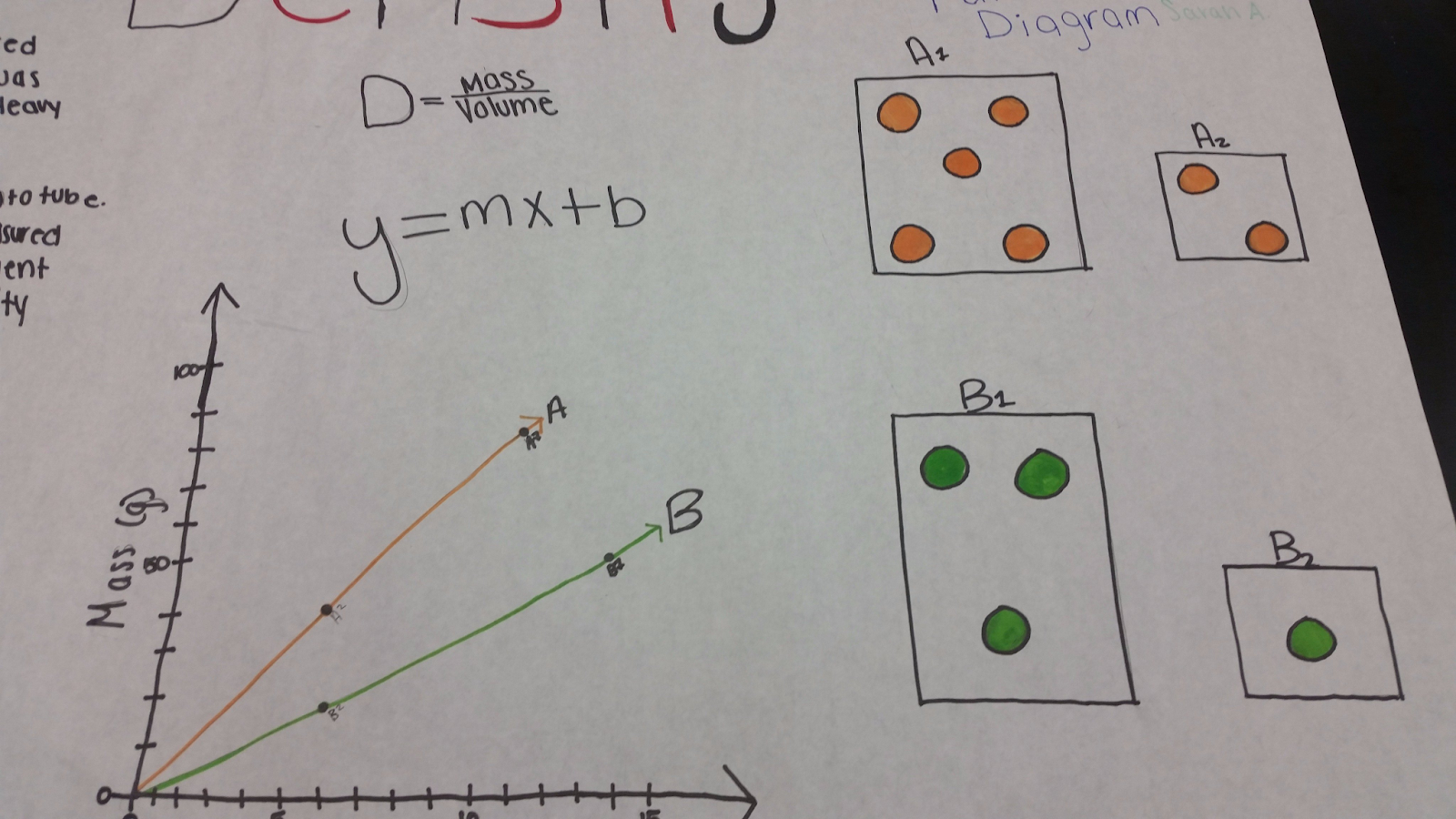
Sample progression using "density" model.

How would a student define density after each point in the sequence?


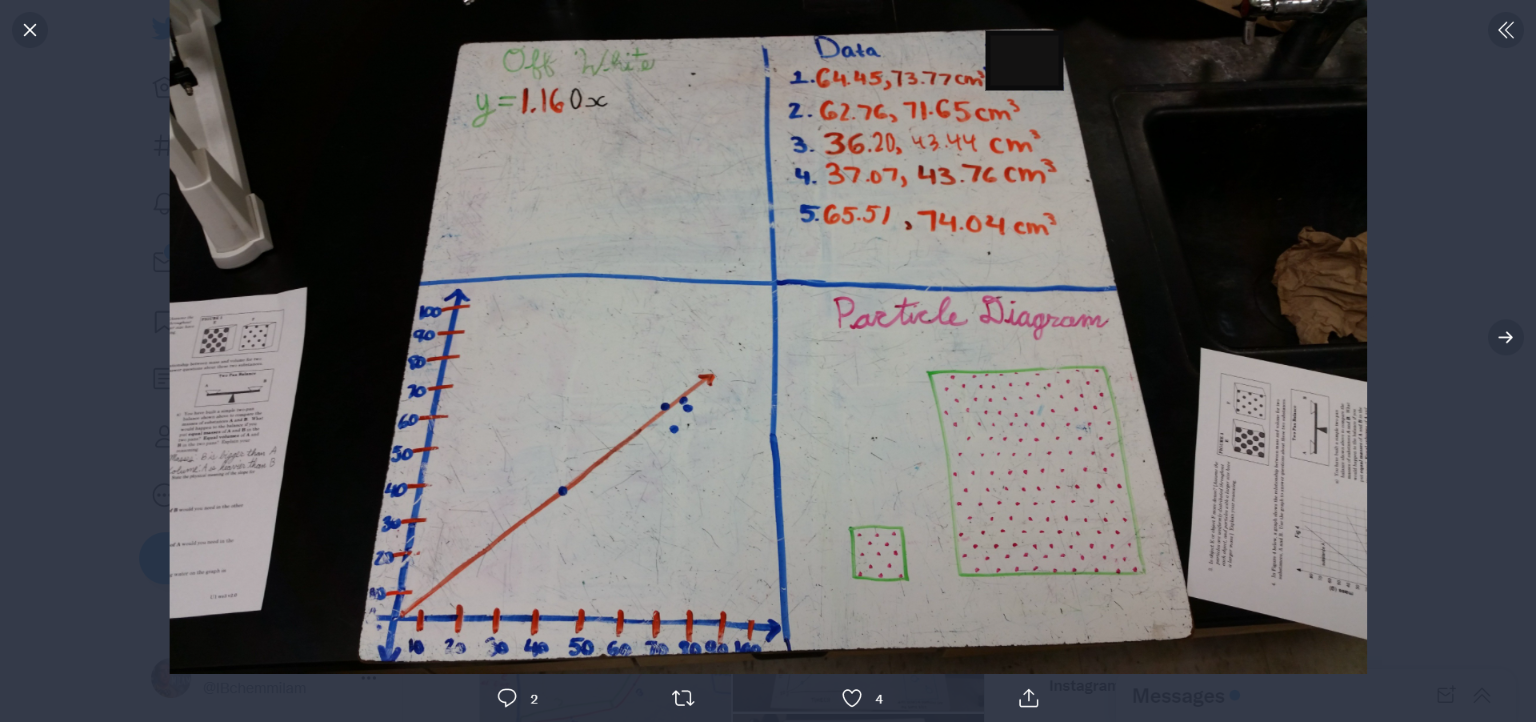
Figure 1: Whiteboard of student measurements of mass vs. volume of a series of blocks

made of a single material. 


Figure 2: Students deploy density model to compare mass and volume relationships at

the particle level


Figure 3: Review poster where student connects representations of “density”


Figure 4: Discrepant event testing the new model of density: Will it float?


Video of wooden blocks with and without holes:


Sunday, September 15, 2019

Student Teaching Reflections

Lessons from student teaching
Classroom management
1. New teachers struggle to be direct. Learn what you want, then tell students what to do. Practice saying things like “I need you to put your phone away and pay attention” because it can feel unusual the first times you are in a role of authority. 
2. Avoid negotiating, compromising and undermining yourself when instructing students. Never say things like “you’ll need to know this for the test” or “if you pay attention for two more minutes maybe we can skip the next part.” 
3. Be wary of small things students do to test you. If you let them get away with minor things they will devolve into bigger things. It’s better for everyone to be clear about expectations at the start with the minor infractions. It is easier to correct something minor for you and the student.
4. Provide feedback when whiteboards are what you want and what you don’t want. We had issues with clarity and students writing instead of drawing. 
5. Students being noisy can wear on you mentally. It helps to pause, think about exactly what you want them to do, why they aren’t doing that and be persistent in communicating. 
6. There are 3 ways to engage someone’s attention. What your showing them can be engaging (content), you can be engaging (teacher) or they can talk (student). Work in all three of those.
7. When you are new, content is a struggle. So rely on your personality sometimes to help students focus. 
8. If students aren’t focused have them write something.
9. Move students’ seats around every unit so they do not stagnate into cliques. 
10. Measuring student infractions can be helpful for giving specific feedback. This should not be used to shame, just for information and to avoid bias.
11. Avoid getting in a trap where you always yell at the whole class. You can tell the whole class once. After that you should be talking to the individuals who are making infractions.
12. Some teachers have the expectation that all 180 students will behave and learn perfectly. Then they get upset when things don’t go according to plan. This is unrealistic and you should be mentally ready for deviations. Expect them. 

Grading
1. When students anticipate quick feedback, they work harder and produce better quality work.
2. Don’t make comments on student work, it’s ineffective use of your time and instead share feedback with all of your students 
3. Grading is exhausting. I try and set up my grading into chunks so I get some positive feedback when I finish a chunk. 
4. After grading a test is the best time to reflect on your teaching for the unit
5. Learn how to stay ahead of grading so you minimize questions from students and parents. Up front communication and timeliness will save you time. 

Teaching philosophy
1. Students are often put into diverse settings in a classroom with no instruction or guidance from adults. You are responsible for teaching them about how their perceptions can undermine their interactions with others. 
2. It is hard to teach. Often when we seek the easy way in teaching there is a transactional cost. If you use grades to keep students quiet, they will be quiet but you undermine their learning and your grading system’s integrity. It’s better to teach them to be quiet, but it’s also more work to do what’s right.
3. You can’t always do everything correctly in teaching. You should work towards it, but know that it’s ok to take some shortcuts.
4. When teaching goes well it’s awesome. Having students engaged and learning is a great feeling. Don’t ever forget how challenging and awesome teaching is.
5. It is totally acceptable to be kind to students even when they frustrate you. 
6. Try something new a minimum of four times a year. If it doesn’t work well, be glad you know.
7. You should be critical of your teaching, but you shouldn’t take it personally. As a new teacher you want to improve, but not in a toxic manner where you feel bad about yourself. The teachers you surround yourself with can influence this quite a bit either way.
8. Defeatist language is bad. Don’t let students say things like “I don’t know anything” or when you ask which problem was hard they say “all of them.” Correct them when they do this or it harms the whole class.
9. Learn to identify what the problem is and what the solution is. If students aren’t focused, your good teaching doesn’t matter. It’s always better to stop and redirect. 


Chemistry content
Unit 1 Measurement, mass and volume
1. What is the physical interpretation of the slope? What would a “for every” statement be for it? What are the units for the slope?
2. The slope of the y=mx+b for mass vs. volume can be used as a model to predict masses and volumes. The slope gives us some information about the particle level difference between substances with different densities.
3. Measurements are not numbers, they are ranges. The rules for rounding answers that stem from measurements are specific to maintain the appropriate level of uncertainty. It is helpful to show students examples with ranges (IE 6x4 = 20 but 6.0x4.0 = 24). The analogy of having about $5000 and finding a quarter, now how much do you have?
4. Students have bad ideas about particle spacing for solids, liquids and gases from illustrations in middle school. It takes a lot of effort to break these down in spite of clear cut evidence. 
Unit 2 Gas Pressure
5. There are direct/inverse relationships and there are directly/inversely proportional relationships. The distinction matters a lot. 
6. Sometimes gas particles collide more frequently, sometimes they collide more frequently and with larger collisions
7. All particles move all of the time. Evidence for particles in solids moving can be how solid objects feel cold and hot based on how fast the particles vibrate against your skin particles. 
8. Splitting up gas pressure demos into time segments greatly enhances your ability to dig into what’s happening. Look in particular for small amounts of water leaking or subtle volume changes 
9. Students get confused when you change three variables at once (PVT) because they overthink things. Keep them focused on two changes at a time, and towards the unknown variable. 
10. For the mason jar demo the small amount of water leaking opens up the discussion to higher levels
11. For the balloon in the bell jar demo ask how the pressure in the balloon changes 
12. For the can crush or balloon in flask, ask whether the pressure in the open flask while boiling is higher, equal or lower than the air pressure in the room.
13. For some demos, the change in temperature (kelvins) is insufficient to explain the magnitude of change (can crush, balloon in flask) n and V might also be changing
Unit 3 thermo
1. Heat is a term that meaning has become too diffuse. Use thermal energy instead to get better understanding. 
2. For specific heat capacity, students will mix up Q with C so its important to use their units to differentiate what they are. 
3. Heating curves are a struggle and students need more than just a curve with water. It helps to talk about slope and length of phase changes and how they can change.
4. Use blocks of various masses and temperature changes to test whether students understand specific heat capacity.
Unit 4 elements, compounds, mixtures
1. Volumes of gases can give information about what a compound might be, what can be done with solids?
2. Sometimes when we don’t know something, we can just assume something and see if it works
3. If a rock has the same % of each element no matter the size or source, that indicates whether it is a compound or a mixture
4. Separating mixtures can be done via distillation (boiling points/stickiness of particles), filter paper (particle size vs. filter hole size) or chromatography (stickness relative to the stationary phase).
Unit 5 moles
1. When teaching moles, the molar mass can be represented as a for every statement, a conversion factor, a means to compare amounts (if 18.02 g is 1 mol, 84 g must be more than 1 mole), it can be represented using pictures and it can be used as a relative mass.
2. Students that don’t know how to convert actually don’t understand what the molar mass means. 
3. When students struggle with math, it helps to add more units and labels in. It’s harder initially but helps them move past basic manipulations into what they are actually doing and using. 


Cognitive Science
1. The amygdala can have a big impact on learning. If students are angry or in fight or flight mode the ability to learn plummets. If students are happy they have stronger connections to what they are learning. This is why we easily remember movie quotes and songs. 
2. Asking students what they learned at the start of class gives them a chance to reflect and will help them do better in their other classes. If you do this consistently, they will work harder to remember other lessons. 
3. Students can’t learn when they are frustrated. But you also should not interfere with their learning to reduce frustration.
4. Don’t start worksheet problems with your hardest problems. Start with the easiest ones and let them figure things out without samples from you.
5. People believe things if you offer a reason, even if the reason is nonsense. They just hear that there is a reason (copy machine experiment)
6. Feedback should be more work for the student than for the teacher.

Discussions
1. Discussions are enhanced when students work towards finding out what they know instead of seeking an answer. Seeking an answer leads to limited participation, frustration and racist/sexist beliefs. Students that can practice starting with what they know learn more effectively with less frustration. 
2. It is imperative that students learn to put effort into their whiteboards during unit 1. They should use color coding, they should measure carefully, they should follow all instructions, they should think about what they’re doing, their particle diagrams should be clear what the intent is.
3. Whenever possible, call on students instead of taking volunteers. Volunteers show that you care about getting the right answer from someone. Cold calling shows that you want to know what a student is thinking. Use dice and a seating chart to find a random student.
4. You’re always talking to the whole group even when you’re talking to a single student when you’re in a circle. Project and be loud.
5. Discussions are very hard to lead when you’re new to teaching. You can get better by planning questions as you observe what students put on their boards. Find errors, unique representations, mathematical variations and start writing down questions to ask.
6. Learn to pause so students talk more. 
7. Phrase your questions so students can opine rather than be led. It’s better to ask, how small is 0.001 cm and see what students come up with than to ask “Do you feel like 0.001 is one of the smallest things you know of?” 
8. Talk about things you’re passionate about. Bring up past experiences and memories. They help increase learning retention and forming neural pathways.
9. Slow students down when they talk about similar topics. Mass, volume and density are all different but related. This means students will often substitute one when they mean another. 
10. During discussions you want to push back against student ideas to force them to think more, but you want to push back against the idea not the student. To do this you want to speak to the entire class and not interact too directly with a single student.
11. Don’t do thinking for students, but it’s good to frame what we’re discussing to focus the attention and reduce the cognitive load.

Miscellaneous
1. At Open House talk about what you’re passionate about. Don’t just give a presentation on mundane details but talk about some of your favorite things. 
2. Strategies to learn students’ names. Write down pronunciations on a seating chart so you don’t have to ask repeatedly or feel uncertain later. Put in a grade for students. Use retrieval practice when students are working. Use their names when you talk to them. 
3. Don’t answer student questions during the test. They can figure out the answer from the information on the test. By answering you are either being unfair or you are cementing in a wrong thought. Better to always shrug and explain ahead of time why you won’t answer.
4. It’s good to have a list of things you’d like to talk with students about that take 5-10 minutes for when you’re ahead in one hour (cognitive science, anti-racism, specific scenarios in school)
5. When you leave sub instructions that involve whiteboards, have students sent a photo to your email or twitter account so you can see how they’re doing.
6. Prepare for interviews by making a list of things you want to say (student situations, student work, specific lessons, books, philosophies)
7. During conferences, be wary of shouting praises for parents who might be having a rough conference nearby you.
8. During conferences, lots of parents just want to know that their child is happy during class and what they are like. 
9. Don’t criticize yourself to put yourself down. Only do criticisms that are productive.

Questions to ask
QTA 1. What would a measurement that was on a 10.00 cm line be written as?
QTA 2. A block of wood floats in water, what will the same block that has multiple holes drilled out do?
QTA 3. How do measurements or significant figures differ from numbers in math class?
QTA 4. #2 and #3 on worksheet 3, does a larger density imply more particles in the same space, bigger particles (or both)?
QTA 5. Can you show me a whiteboard that highlights what you’re explaining. This came in handy for when students explanations were unclear or confusing.
QTA 6. what makes Fierce cologne particles move the way that they do?
QTA 7. Does the pressure increase from more collisions, bigger collisions or both? 
QTA 8. What makes the particles move? If particles collide, what does that imply about their motion?
QTA 9.  Which is hotter, a teacup of boiling water or a bucket of warm water?
QTA 10. What is a compound and how is a mixture different?
QTA 11. Can water ever not be H2O? Could it be H3O? 
QTA 12. Do we have more or less than 1 mole?
QTA 13. What does the number 22.99 mean for Na?
QTA 14. What does the number 18.02 mean for H2O?
QTA 15. If there is 1 mole of CaCO3, how many total atoms and O atoms are there?

Weaknesses of Milam (find someone else to learn these from)
Weakness 1. I am not good at organizing the physical layout of the room. I don’t have a space for everything and I don’t throw stuff away frequently enough. 
Weakness 2. I am off topic too frequently and this detracts from my lesson timing.
Weakness 3. I’m arrogant. It’s getting better, but it’s still not good. 

Strengths of Milam
1. I see the good in all kids. I don’t let their mistakes define my perception of them.
2. I can anticipate what students don’t understand and ask good questions that allow them to do the same.
3. I reflect constantly about everything.
4. I’m creative and have fun at work.
Thursday, July 25, 2019

ChemEd 2019

I just returned from ChemEd 2019 and I could not be happier. I had a four hour drive to think about the conference and about teaching. The complexity involved in teaching is overwhelming at times. But as I improve in teaching the complexity becomes such a joy and conferences are a huge source of that emotion. Being around some of the best chemistry teachers in the world is so intellectually stimulating to me.
Teaching is complicated. You have to understand some information, deliver that information to a novice learner and work towards their brain changing in a meaningful manner. Their brains will filter much of that information and that which does arrive successfully runs the risk of becoming forgotten. Racism, sexism and other power structures can affect both the delivery and reception of that information. Emotion and the amygdala can also interfere. Between the cognitive science and the sociology there lies chemistry. Chemistry is a beautiful subject to teach, but it is also incredibly complex. So teaching is the intersection of all of these things. A teacher has to be able to account for all of them with a collection of students that vary considerably in their initial understandings and knowledge that they can use to make new connections. There is no limit to how far you can push your cognitive limits as a teacher.
So I feel that as my preparation and experience improves, I am getting to a point where I can effectively navigate all of these. But it’s hard. And the many cycles of preparation, teaching and reflection are needed to become masterful at teaching. The ChemEd 2019 conference had so many teachers that were brilliant. To just watch them teach us was amazing. It felt like the concept from the book “Inner Game of Tennis.” My system 1 was just learning without my conscious mind interfering. But in addition to the teaching technique, there was also an abundance of creativity. An artistry or uniqueness that I loved watching and dissecting. 
My favorite part of teaching is this vast combination of cognitively demanding tasks that all require improvement. I think that teaching is the ultimate cognitively demanding profession and we talk about this too infrequently. I appreciate the sheer difficulty of doing this well and so I am incredibly happy when I get to observe someone doing this at such a high level. I find it so impressive when someone can combine so many tasks but also add in creativity. Being able to reflect and critique things afterwards with a group of teachers is the best. I also feel that the presentations have changed in the last few years. The level of elite teaching has stretched so high and I wonder if it would be fruitful to consider intentionally pushing for a localized arrangement of elite teachers to see what could be accomplished. I wonder what we could do if we intentionally arranged a cohort of teachers and gave them a working environment that was modeled after a conference like this. 
Sometimes when we teach we repeat things so frequently that complicated concepts become algorithmic and automatic. Some refer to this as saying I learn the best by teaching. But as we shift teaching into responding towards initial student models the cognitive demand becomes so much higher on teachers. It’s not just a transfer to long term memory of phrasing or algorithms. It is that deep thinking that is challenging and rewarding. And that means that the intellectual stimulation also rises with it. And I love it. I know that many avoid recommending the teaching profession, but I can’t think of a better job. There is nothing that I could do that push my thinking more than teaching does. And some of the new educational pedagogy provides such an opportunity to push yourself in ways that have not existed before. To me, the conference felt like I was surrounded by people who derived the same joy that I felt. I hope to be back at one soon.

Sunday, March 10, 2019

Daily student recaps

On a Saturday in late fall we held a follow up to our modeling workshop. One of the participants brought a colleague along with her. During one of our discussions she mentioned that she had been having students do a daily recap of the previous lesson. I thought the idea was brilliant and so I started having my IB chemistry HL class do it. I recently expanded the recaps to my chemistry classes. There are multiple benefits to doing this and I wanted to put them together and encourage teachers to try using this tool in your own classes.
1.  Students listen differently to their peers.
When I talk, the students trust me to say “correct” things about what we are learning. When a student is explaining that trust is not there. This causes students to listen differently with a more critical approach. If a student says anything that is slightly wrong or even if the letters they write are slightly misshapen they notice immediately. This type of critical listening is very valuable for student learning. They’re connecting topics and ideas and evaluating whether they fit or don’t. They should do this when I speak. Pointing out to them this discrepancy can be helpful for pushing their learning to a higher level.

2. What I think students know and what they actually know are frequently different.
Being able to see what a student took from your lesson is helpful. Sometimes teachers get wrapped up in the world of “But I told them once, they should understand it!” Spending time listening to students every hour to start things off builds a much better perspective of what they are learning instead of what you are teaching.

3. More student voice
At the start of this year I was nervous to call on quiet students during discussion. In the past students had given feedback that they would participate but that talking in front of everyone terrified them. It was a mistake to listen to that feedback. It created an unhealthy class dynamic where students sought out correct answers instead of focusing on what they currently understood. It pushed the idea that there are smart chemistry students and dumb ones. It was also racist and sexist in that some races and gender combinations were heard from more than others.
However, this is a concern for students and it needs to be handled well to be successful. When students say “I don’t know” during discussion, you’ll want to emphasize that the solution to not knowing something begins by starting with what you do know and building connections to those ideas. Frequently teachers undermine this by making statements about “being happy about mistakes” or “mistakes are opportunities to learn”. Instead it’s important to show students how to cycle through learning something new by seeking out a starting point of what a student does know and how to evaluate possible explanations, logic and evidence to build towards the new learning objective.
It is important not just to say this, but to keep a healthy approach as students do the recaps. Many are nervous but I see a lot of that disappear as I point out the good points of their recaps. As they realize the intentions of finding out what they know they produce more honest recaps. I would also like to say that I am frequently surprised at students that I would expect to struggle with a recap because they are quiet. These students are perfectly capable of doing an excellent recap and hearing from them improves their inclusion in the classroom.

4. Spaced practice
Spaced practice is the opposite of cramming. In cramming a set of ideas is repeated until familiarity sets in. In spaced practice the learning is split up so that forgetting occurs between the intervals of learning. The research strongly supports spacing practice. By allowing students to forget and then re-learn the material the impact on the brain is substantial. Doing a daily recap allows students to forget part of the material and then relearn it the next day. This leads to less forgetting and also better understanding.

5. Reflection
Students know that the next lesson will involve a randomly selected student giving a recap. When two or three minutes are left in a lesson the students can then reflect on what they learned and what they would present if they were to be selected the next day. This can help them evaluate and organize the learning.

This is a new technique to me but the value is already immense. I have thoughts on how to modify the technique such as having two students selected. One gives the recap and the other supplements additional ideas. The time varies because most students will talk for 5-6 minutes and not realize they had talked so much. Some teachers might elect to tell students the day before who will speak (which could be an issue if there is an absence). I roll dice to determine who will speak and they get no prep time to pull things together. Currently students can bring notes with them but they are discouraged from using them and not allowed to just write what their notes say. If they get stuck they are encouraged to ask questions to other students.

Wednesday, February 13, 2019

Kroger ads are over the item limit for the anti-science express lane

Going grocery shopping can be quite obnoxious for a chemistry teacher. It’s not just the chemical-free labels but rather an overwhelming amount of misleading and deceptive marketing. It is a stark reminder that there are relentless forces pushing back regardless of how hard I work to teach science, evidence-based thinking and chemistry knowledge. For every time a student learns how to predict the products of a chemical reaction they will be inundated with non-GMO labels. Every particle representation that pushes their thinking will be countered by claims that only ingredients with names that can easily be pronounced are used.
These marketing schemes cause a widespread distrust for many things like aspartame, vaccines, MSG and other items that have had false data perpetuated by public hysteria that lacks any evidence. The impacts of these cause a rift between environmental activism and environmental science. And I understand that people do not always have access to trustworthy sources and the risk of getting scammed an extra few dollars is less worrisome than the false alternative. So while I wish more people would buy food that is better for the environment, better for the health of farmers and not actively trying to scam innocent people out of money, I understand why that takes time to transition.
But I am less forgiving of the advertising for those that are aware of these marketing scams like the non-GMO project that help perpetuate fears among consumers just to profit off of their fear. Companies with the resources and knowledge to do the right thing and educate consumers get far too little criticism when they choose instead to push fear-based rhetoric. The following two advertisements are from Kroger’s Simple Truth brand and the second I heard on the radio one day and it infuriated me.

Ad 1 “We’re proud of what’s not in our food, like GMOs (disgusted tone)” https://www.ispot.tv/ad/dlAO/simple-truth-were-proud
Ad 2 “Free from GMOs and free from things you can’t pronounce”

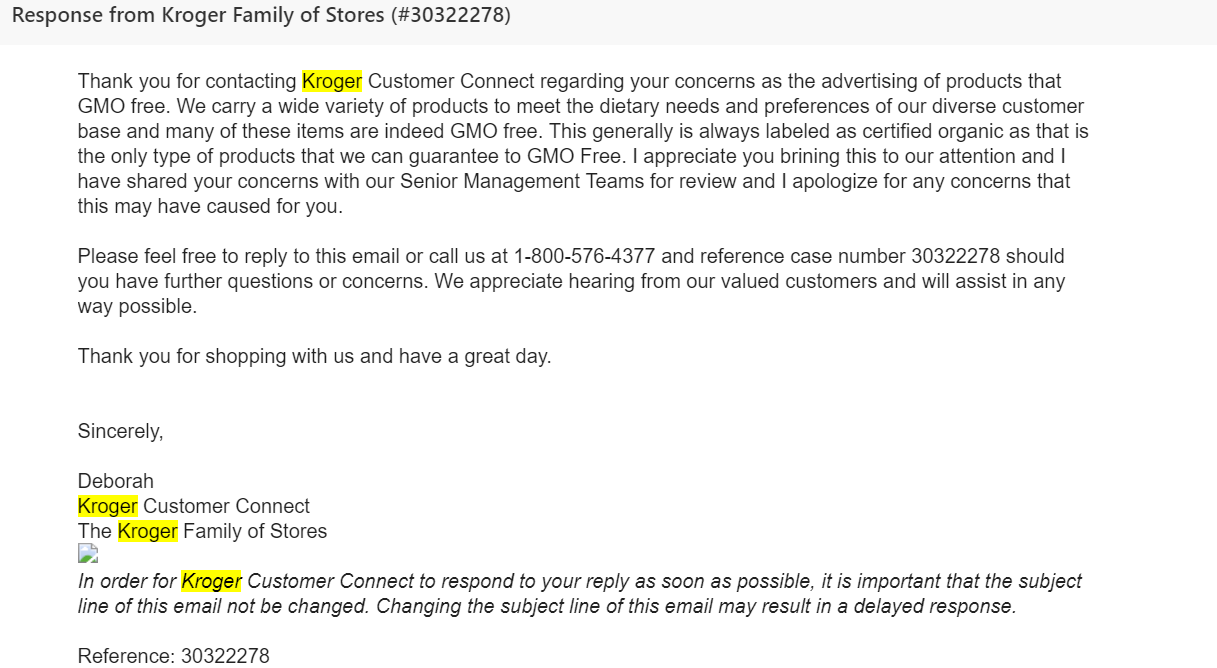
I wrote about how the advertisement made me feel and received a reply that showed that Kroger both did not read my comment but also apologized for my confusion rather than address their deceptiveness. Their response is Figure 1 found below. Several response emails were redirected with claims that my concerns would be forwarded to marketing and I couldn’t help notice that Kroger was perfectly content to explain how their food was non-GMO initially before they took time to understand my complaint. But once they were aware of everything the evasiveness grew.
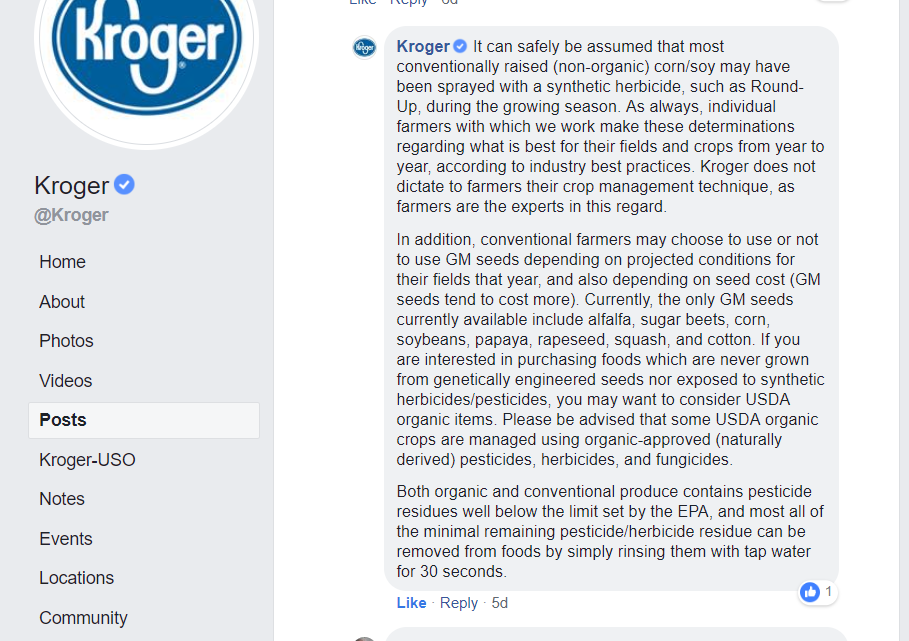
Eventually I received a direct response and explanation (Figure 2 below). While I appreciated an actual response I still feel that Kroger is both disingenuous that they have no knowledge of food systems and farming and are merely responding to consumer requests. The advertisements clearly show they are pushing consumers in a particular direction both with their tone, phrasing and the pronounceable ingredient comment in ad 2. However, I also have hope that they will respond. While Kroger was avoiding my emails I looked through their social media and found a brilliant response where an employee took the time to thoroughly explain pesticides, organic pesticides and more to a customer that appeared to not be aware (Figure 3 below).
So if you are a science teacher, an environmentalist or someone who’s just tired of having the dumbest possible labeling shoved in your face everytime you walk into a grocery store, please consider sending Kroger a message letting them know you would like to see more pro-GMO marketing, more educational labeling and fewer chemophobic messages. If you'd like to learn more about GMOs here are some helpful links. Ingredients in a banana can be found here. If you can pronounce it you should eat it meme.
Figure 1: Initial email response from Kroger after my complaint that their advertisements promoted anti-science

Figure 2: Email response from Kroger after I asked for a medical condition that would be positively impacted by a non-GMO diet


Saturday, May 5, 2018

I Don't Hate Grading Anymore


I hate grading.  Grading takes so long and marking wrong answers for hours on end after spending so much effort on teaching is an emotional drag.  Grading isn’t just obnoxious because it is redundant, length and often mindless. For high school teachers it can often be used as a tool to shame students, to make them feel bad about themselves and that blame is tough to share and unhealthy to deflect to students and their parents.  

I was listening to a podcast about how we do not remember our memories correctly.  We replace our memories with what we currently believe as often as possible because of how brain storage works.  If you currently are aligned heavily with a set of political ideologies, you are likely to shift your memories towards those same ideologies.  But I couldn’t help listening to this podcast to think about how grading affects teachers negatively. When teachers grade they see the correct answer 170 times.  They even see the wrong answers so frequently that they will often tell the next group in advance of what mistakes they will make. So when a student repeats a mistake it can produce an unhealthy response.  We think of students as lazy or that they don’t care. This happens especially when teachers are put under external pressure from administrators, parents and even the students themselves. And as we continue this year after year we eventually reach a point where it is beyond the teacher to remember what it was ever like to learn the material for the first time.  We shift our memories to think of our subject matter is being so clear and simple that we disconnect from reality.

About six years ago I was going through my files and I found a set of exams from when I was in college studying chemistry.  I looked them over and a multiple-choice question from my advanced thermochemistry class caught my eye. I read a question and saw that I had gotten it wrong.  It was about entropy, enthalpy and spontaneity and I got really upset at myself for getting it incorrect. In fact, I remember thinking how furious I would have been had one of my students, even a struggling student, if they had made the same mistake I had made in my third year of college.  I had taken high school chemistry, AP chemistry and was over 30 credits of chemistry in to my degree when I made that mistake.

I think that moment has prevented a lot of negativity towards my own students as I now can remember with a little bit of evidence that sometimes students know something but struggle with the mechanics of the question, sometimes new information makes us uncertain and sometimes it just takes time to understand a concept.  When students get questions wrong I no longer take it personally. I will never get angry at a student for being wrong or needing more time to understanding something. If a student or parent tries to push an unhealthy pressure on me I feel comfortable deflecting that pressure away and not engaging with them. And I believe I just found the perfect grading system to make this all work.  

I have now been using standards based grading assessments for the past three years in my chemistry classes.  This has been a minor change as it is really just chopping up the test into sections that focus on 6-10 concepts from a unit (examples are on my chem website).  I liked the organization and felt that it improved feedback to students and parents.  But in the past two weeks I have started to add one last feature and I think the slight increase in grading is about to be overwhelmed by the reduction in mental health stress in grading.  Students will now be able to reassess on standards.

The logistics I am currently planning on using involve having students complete a form for any standard that they wish to reassess that focuses on directing students back to what we learned in class.  They can then improve their understanding of the topic and reassess. Reassessments will happen once per week on a rotating after school and lunch schedule that so far has been very reasonable to execute.  The following year I will join with the teacher next door to me so that each of us is only responsible for every other week to supervise students reassessing.

Grading still is not fun, but the last two tests that I have graded I have felt so much more at ease with student mistakes.  It is no longer an omission that will compound as the year progresses, but instead feedback that the student can rectify and incentive for them to reflect on their understanding as well as what they accomplish during class time.  It is no longer an indictment of my teaching but instead feedback to me on what went well and what did not. It is no longer a cycle of two week periods where students rush through material, but instead this allows us to slow down when needed without losing content.