Showing posts with label science. Show all posts

Saturday, January 11, 2020

Cognitive Science of Energy in Science Education

The cognitive science behind teaching science shows that abstract ideas should be connected to concrete examples to maximize understanding. Energy is an abstract concept, yet little analysis of how to best connect energy to concrete examples exists. The experiences of teaching both chemistry and physics have provided me some insights into what teachers should do to help students understand scenarios that have traditionally been analyzed using energy. 
Motion, position and force are more concrete (less abstract) than energy. Whenever possible energy should be removed from the explanation or discussion and replaced with these. When students use energy with regards to kinetic or gravitational potential energy they have an easier time processing new information. Asking students which has a larger kinetic energy when comparing an object at different speeds is easily transferable between the abstract energy and the concrete speed. The other two forms of energy that are easily visible for students are spring energy and gravitational potential energy. 
Showing students a relaxed spring and a compressed spring allows them to easily identify that the compressed spring has more energy. Holding a marker a meter off the ground and two meters off the ground easily allows them to identify that the two meter mark has more potential energy. The reason why this is easily analyzed by students is that they easily connect to the concrete. The students can see that upon release, more motion results from the compressed spring and the elevated marker. Note that for both instances the concrete image of fast moving objects is easily accessible. In Figure 1 below, it is obvious that when released object B will be moving faster right before it hits the ground than object A.
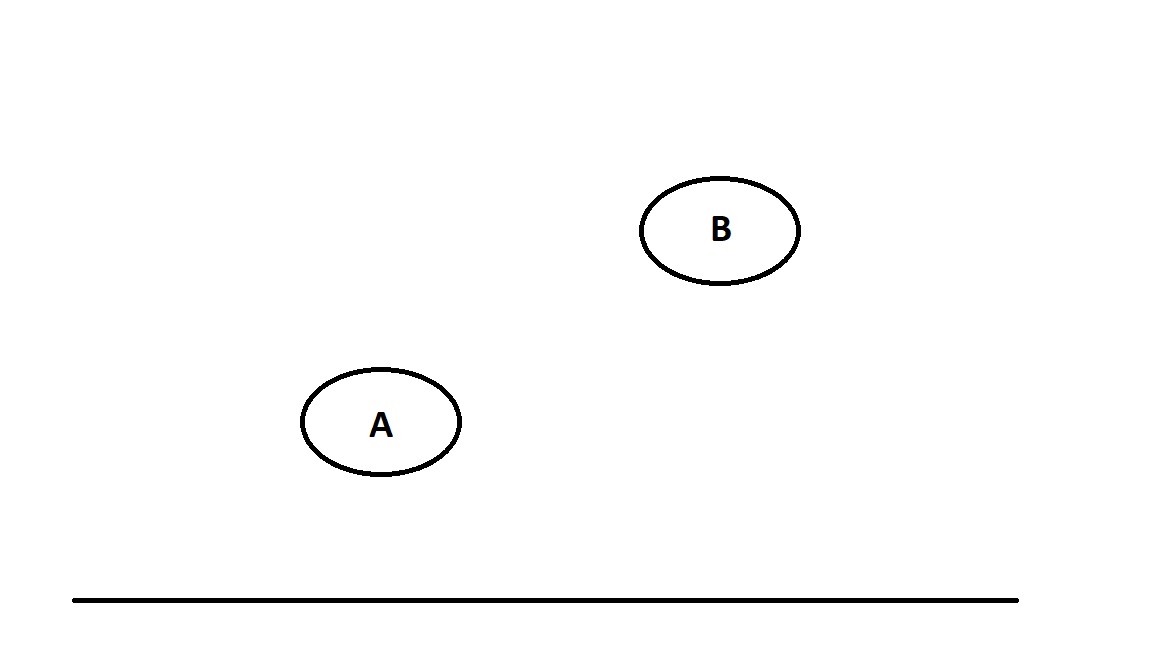
Figure 1: Two objects where object B is twice the distance from the ground that object A is

When is it not clear?
Energy remains obscure with charged particles and electrical energy. A simple explanation is that charged particles have two competing abstract ideas visible to students. When a proton and electron are close together the students understand that there is a larger force between them than when they have a large separation. But these particles have less energy than particles that are separated. To reconcile these two competing ideas it can be helpful to track the relative speeds. If an electron and proton are separated by a distance and released, they will move towards each other and collide (ignoring quantum physics). If the electron and proton are now separated to twice the distance, they will approach and collide, but at a higher speed than before. When they reach the original separation they will have that kinetic energy gained plus the same potential energy as before. 
Figure 2: Top two charges start separated by a distance d. Middle two charges start separated by a distance 2d. Bottom two charges started at a distance 2d but have moved to a distance of d and are now moving with a relative speed. 

It takes time for students to connect the ideas present in Figure 1 above. Often in chemistry we exacerbate this by labeling the potential energy without specifying whether it is potential or kinetic. The middle set of charges has more energy than the top set of charges. This is difficult for students because they see the forces as being larger for the top set and have experienced the stronger attraction when playing with magnets. 
This is not as problematic with gravitational potential energy because the force of gravity is relatively constant because of the small change in distance relative to the large separation from the center of the earth. Students also have substantially more sensory experience with gravitational interactions then electric. 
Energy by definition should be linked to a force. Energy and work have circular definitions, but the mathematical origins of energy are an integral of a force over a pathway. For example, gravitational potential energy (mgh) is derived from the integration of weight (mg) for the pathway of separation between the two objects. This conflicts with the presentation of energy in science classrooms frequently. Chemical energy, sound energy, “heat” energy and many other forms of energy are not directly linked to a fundamental force. Chemical energy for example is based on electrical forces. “Heat” energy or thermal energy is based on kinetic energies of particles. 
By introducing energy in terms of conservation of these forms that do not have a direct link to a force, we obfuscate the underlying abstract definition of what energy is. This conflict allows students (and teachers) to maintain a wide variety of mental models of what energy is. The current push for developing models of energy in the NGSS is insufficient to undermine and may actually reinforce the problem. 
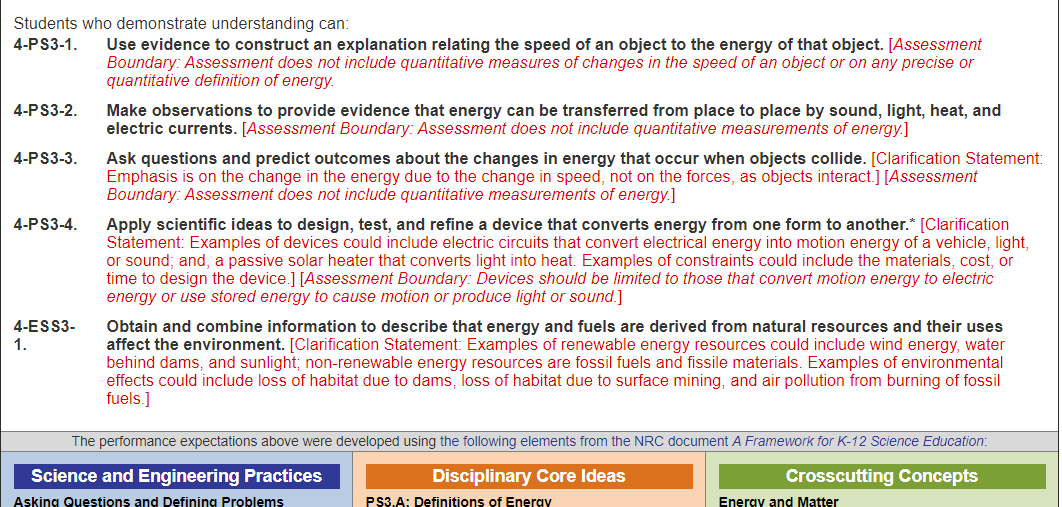
Figure 3: NGSS that deal with energy, taken from https://www.nextgenscience.org/topic-arrangement/4energy on 1/9/2020

In Figure 3 we see the idea of conservation as fundamental to 4-PS3-2, 4-PS3-4 and 4-ESS3-1. 4-PS3-1 shows some promise but also undercuts that potential by making this a mathematical connection instead of dealing with the conflicts discussed above. None of these set up for students to challenge the underlying struggle of unpacking why electrical energy increases as separation between charges gets larger. 

How should teachers attack this misconception?
An abstract idea is understood better when multiple concrete examples are used. A strategy that I have found helpful for this is to limit energy in education. Every scenario that is explained using energy can also be explained using force, position and motion instead. By eliminating energy from the explanation you require a concrete connection to be the impetus for understanding. This is challenging and often unique. Could you explain how digestion works without using energy in your explanation? Could you talk about how light and electrons interact without using energy? Can we differentiate a nuclear power plant and a coal one without energy? The answer to this is always yes, but it requires practice. 

Chemical Reactions 
Energy in chemical reactions can be presented in many formats. One common format is using reaction energy diagrams. A reaction energy diagram is extremely abstract. The abstraction can be reduced using simple diagrams for a reaction. With a very generic reaction energy diagram teachers can communicate simple abstract ideas to students without the student being forced to develop a concrete example. Teachers can highlight that the potential energy of the chemical system has increased as the reaction proceeds in Figure 4. 
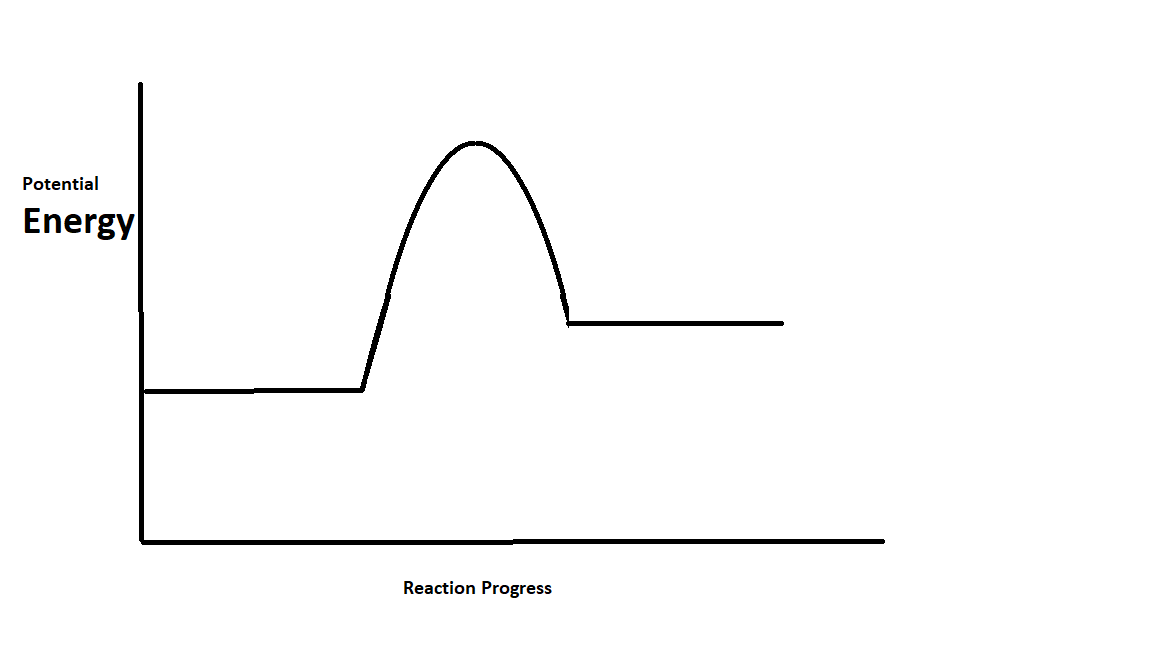
Figure 4: A generic endothermic reaction energy diagram.

Figure 5 is an improvement because it allows students to develop the idea that transition states are unstable. This makes some intuitive sense to the student that the more common representation of a bond is stable. But in order to really advance the model for students one must address the underlying potential misconceptions. This is to be done by marking down how the forces, positions and motions all relate to one another.
Figure 5: Particle representations that show the reaction transitional state where bonds have broken but not yet reformed. 

From the initial reactant state to the transition state, B moves away from A. A and B are attracted to each other so the forces are inwards while the motion of A and B is outward. In order for A and B to move apart while forces pull them together, they have to slow down. If you are moving left, and being pulled right, your speed lessens. What we’re describing here is a transition from kinetic to potential energy. When a collision occurs that causes a large relative motion between A and B, A and B can separate. But to do so they slow down. If a small collision occurs, A and B will start to separate but will revert back to their bonded state before completing the separation. 
When C and B approach each other the force is again inwards. But now B and C are approaching each other. Their motion and their forces are aligned and so their speeds increase. As the bond forms their speeds increase and later that increase in motion could be transferred back to the surroundings through collisions (heat). Note how by analyzing this without energy the student is not going to develop the biology misconception that breaking bonds releases energy. Students often see the transition from ATP to ADP as a bond breaking that releases energy and retain this idea in chemistry and physics. When ATP turns into ADP it is not a single bond change that occurs. Here the students can logically process that the particles are going to slow down as bonds break and speed up as bonds form. Now when a reaction is endothermic they can infer that the bonds were harder to break. When a reaction is exothermic the initial bonds were easier to break and the particles sped up more than they slowed down. A video breakdown of this schematic can be found here. 

Digestion
Why do you eat food? Because it gives you energy. How does photosynthesis work? Plants turn light into energy. The questions and answers that surround digestion are filled with abstract hand waving. I am not a biology expert so if my explanations are flawed, please try and focus on the development rather than the specifics. 
When you consume food your body changes that food into smaller pieces and distributes those pieces throughout your body. Much of that food turns into a sugar called glucose. Cells use glucose by burning it. The glucose reacts with oxygen and as this happens the products of the reaction move faster than the initial speeds of the glucose and oxygen. That motion is used to push other chemicals together in a way that forms something called ATP from ADP. The ATP and ADP can be used to cause muscle contraction because the charges of the ATP and ADP cause muscle fibers to grab hold, pull on muscle fibers, release and reset. These actions results from the changes in charge distribution within the ADP and ATP that result from the reactions of the glucose changing. 
If the initial warning wasn’t sufficient, the preceding paragraph makes clear that I have a limited understanding of the cycles used as well as the chemicals involved as intermediates. But in reading this many questions that could undermine my ignorance become clear. How does the burning of glucose in cells differ from the combustion that occurs in air? When the conversion forms an unstable intermediate, how does charge distribution play a role? How does the cell distribute these unstable intermediates without a reversion to a more stable set of chemicals? What in the structure of myosin and actin leads to a binding interaction and how is that interaction disrupted? What about its structure makes ATP so effective at distributing charge that causes other molecules to move? Many of these questions have an underlying theme. Charge is being used to push or pull and motion is being used to initiate those pushes and pulls. A biochemistry expert should be able to detail how the chemicals at each stage of digestion leads to the desired result and they should be able to do so without using energy. 

Photosynthesis is very similar but light presents a new struggle. How do we describe light without using energy? Light originates when charged particles change. The exact changes are difficult to describe because charged particles are too small to observe in the same way we view macroscopic objects. We could say that when charged particles change how they move light is produced, but that is probably not completely true and not completely false either. Light originates from a charged particle (electron, nucleus, etc.) and terminates when the light causes a different charged particle to change its state. 
When light hits a chemical, the light can interact with the electrons in that chemical. The resulting changes for the electron that absorbs the light can result in new positions and motions for the electron that change the attractive forces within the molecule. This can lead to attractions being disrupted. The resulting unstable intermediates and transition states can lead to collisions where other molecules are pulled on. Photosynthesis is where light hits a chlorophyll pigment that causes changes to the electronic structure. The changes to the chlorophyll have various pathways that end up using that change to pull particles where the eventual result is combining carbon dioxide and water into sugars. Sometimes the chlorophyll can remove electrons from water molecules that then turn into protons and oxygen. The protons (H+ ions) can build up forming a charge gradient along a wall. Again the details are bit beyond my expertise level but hopefully you can begin to see how an expert would be able to replace the term energy within each of these steps with the result in terms of charge distribution, motion and position. 

Power Plants
When we say that we have an energy crisis, what do we actually mean? What specific things do we mean that we could replace the term energy with? The often mean electricity. We could also be talking about fuels or stuff that burns. 
Nearly all power plants function with the same underlying principles. You have to make a turbine spin fast. When the spinning is connected with a magnet inside a coil of wires you get electricity. The big differences in how the spinning is produced is the primary difference between electricity production. Fossil fuels (coal, oil, methane) are burned underneath a vessel filled with water. As the water turns into steam, the steam particles collide with the blades of a turbine causing it to spin. A nuclear power plant functions in the exact same manner but instead the uranium rods are inserted into the water to heat the water instead of burning fuel. Hydroelectricity uses water to push on turbine blades. Wind turbines are arranged where wind is likely to push more in one direction than another. 
Note how whenever we eliminate the word energy from explanations the details become more concrete. The uranium fuel rods provide energy that heats the water. The uranium particles in the fuel rods split into pieces that move fast. As they fly through the water they drag water particles causing the water to speed up. Fossil fuels provide energy to heat the water. Fossil fuels react with oxygen and after the reaction the products move at higher speeds. When these fast moving particles collide with the vessel containing the water the collisions tend to transfer motion to the water particles. 

Conclusions
Energy allows us a lot of mental and mathematical shortcuts in science that are valuable. Explaining and understanding quantum mechanics without energy is a burden that would exclude many from the field. But there is a cost to using energy. Using energy as an explanation results in less understanding and that cost is too great in science education. Strategies to make energy less abstract include:

1. Explain processes without using the term energy. Use force, motion and position to help guide the explanations.
2. When using energy, it should tie directly to a force (gravity, electric, magnetic, nuclear). Avoid terms like sound energy, heat energy and chemical energy.
3. When something is too complicated to explain without energy, try and split the process into fragments. What do I have at the beginning, middle and end. Can I explain any of these transitions without energy? 
4. Explanations in chemistry must address the misconception that forces and energy are interchangeable for charged particles. Large separations have small forces and high energies.5. Particle level representations can help expose incomplete details.
6. Anticipate having students that ask “How do you know that the energy changes that way?” prior to the lesson and work on answering that question.
7. Be wary of changing forms of energy. Changing forms is useful for calculation simplification but is highly disruptive to student understanding. 
8. When avoiding energy, it is critical to reduce the number of tier 2 and tier 3 vocabulary terms to avoid cognitive overload. Keep everything else simple. 
9. Biology is the hardest subject to do this in. Sometimes though the energy components do not contribute anything of value. ATP changing to ADP allows muscles to contract. Do I need to use energy in that observation? Does it enhance the understanding?

Practice is required to improve at avoiding energy in science education. When teachers feel inadequate to continue they should write down questions they have to see if there is a potential resolution. Teachers should be wary of science education techniques that organize energy into models. This often takes the abstract concept of energy and avoids the ability to make it concrete.

Sunday, September 15, 2019

Student Teaching Reflections

Lessons from student teaching
Classroom management
1. New teachers struggle to be direct. Learn what you want, then tell students what to do. Practice saying things like “I need you to put your phone away and pay attention” because it can feel unusual the first times you are in a role of authority. 
2. Avoid negotiating, compromising and undermining yourself when instructing students. Never say things like “you’ll need to know this for the test” or “if you pay attention for two more minutes maybe we can skip the next part.” 
3. Be wary of small things students do to test you. If you let them get away with minor things they will devolve into bigger things. It’s better for everyone to be clear about expectations at the start with the minor infractions. It is easier to correct something minor for you and the student.
4. Provide feedback when whiteboards are what you want and what you don’t want. We had issues with clarity and students writing instead of drawing. 
5. Students being noisy can wear on you mentally. It helps to pause, think about exactly what you want them to do, why they aren’t doing that and be persistent in communicating. 
6. There are 3 ways to engage someone’s attention. What your showing them can be engaging (content), you can be engaging (teacher) or they can talk (student). Work in all three of those.
7. When you are new, content is a struggle. So rely on your personality sometimes to help students focus. 
8. If students aren’t focused have them write something.
9. Move students’ seats around every unit so they do not stagnate into cliques. 
10. Measuring student infractions can be helpful for giving specific feedback. This should not be used to shame, just for information and to avoid bias.
11. Avoid getting in a trap where you always yell at the whole class. You can tell the whole class once. After that you should be talking to the individuals who are making infractions.
12. Some teachers have the expectation that all 180 students will behave and learn perfectly. Then they get upset when things don’t go according to plan. This is unrealistic and you should be mentally ready for deviations. Expect them. 

Grading
1. When students anticipate quick feedback, they work harder and produce better quality work.
2. Don’t make comments on student work, it’s ineffective use of your time and instead share feedback with all of your students 
3. Grading is exhausting. I try and set up my grading into chunks so I get some positive feedback when I finish a chunk. 
4. After grading a test is the best time to reflect on your teaching for the unit
5. Learn how to stay ahead of grading so you minimize questions from students and parents. Up front communication and timeliness will save you time. 

Teaching philosophy
1. Students are often put into diverse settings in a classroom with no instruction or guidance from adults. You are responsible for teaching them about how their perceptions can undermine their interactions with others. 
2. It is hard to teach. Often when we seek the easy way in teaching there is a transactional cost. If you use grades to keep students quiet, they will be quiet but you undermine their learning and your grading system’s integrity. It’s better to teach them to be quiet, but it’s also more work to do what’s right.
3. You can’t always do everything correctly in teaching. You should work towards it, but know that it’s ok to take some shortcuts.
4. When teaching goes well it’s awesome. Having students engaged and learning is a great feeling. Don’t ever forget how challenging and awesome teaching is.
5. It is totally acceptable to be kind to students even when they frustrate you. 
6. Try something new a minimum of four times a year. If it doesn’t work well, be glad you know.
7. You should be critical of your teaching, but you shouldn’t take it personally. As a new teacher you want to improve, but not in a toxic manner where you feel bad about yourself. The teachers you surround yourself with can influence this quite a bit either way.
8. Defeatist language is bad. Don’t let students say things like “I don’t know anything” or when you ask which problem was hard they say “all of them.” Correct them when they do this or it harms the whole class.
9. Learn to identify what the problem is and what the solution is. If students aren’t focused, your good teaching doesn’t matter. It’s always better to stop and redirect. 


Chemistry content
Unit 1 Measurement, mass and volume
1. What is the physical interpretation of the slope? What would a “for every” statement be for it? What are the units for the slope?
2. The slope of the y=mx+b for mass vs. volume can be used as a model to predict masses and volumes. The slope gives us some information about the particle level difference between substances with different densities.
3. Measurements are not numbers, they are ranges. The rules for rounding answers that stem from measurements are specific to maintain the appropriate level of uncertainty. It is helpful to show students examples with ranges (IE 6x4 = 20 but 6.0x4.0 = 24). The analogy of having about $5000 and finding a quarter, now how much do you have?
4. Students have bad ideas about particle spacing for solids, liquids and gases from illustrations in middle school. It takes a lot of effort to break these down in spite of clear cut evidence. 
Unit 2 Gas Pressure
5. There are direct/inverse relationships and there are directly/inversely proportional relationships. The distinction matters a lot. 
6. Sometimes gas particles collide more frequently, sometimes they collide more frequently and with larger collisions
7. All particles move all of the time. Evidence for particles in solids moving can be how solid objects feel cold and hot based on how fast the particles vibrate against your skin particles. 
8. Splitting up gas pressure demos into time segments greatly enhances your ability to dig into what’s happening. Look in particular for small amounts of water leaking or subtle volume changes 
9. Students get confused when you change three variables at once (PVT) because they overthink things. Keep them focused on two changes at a time, and towards the unknown variable. 
10. For the mason jar demo the small amount of water leaking opens up the discussion to higher levels
11. For the balloon in the bell jar demo ask how the pressure in the balloon changes 
12. For the can crush or balloon in flask, ask whether the pressure in the open flask while boiling is higher, equal or lower than the air pressure in the room.
13. For some demos, the change in temperature (kelvins) is insufficient to explain the magnitude of change (can crush, balloon in flask) n and V might also be changing
Unit 3 thermo
1. Heat is a term that meaning has become too diffuse. Use thermal energy instead to get better understanding. 
2. For specific heat capacity, students will mix up Q with C so its important to use their units to differentiate what they are. 
3. Heating curves are a struggle and students need more than just a curve with water. It helps to talk about slope and length of phase changes and how they can change.
4. Use blocks of various masses and temperature changes to test whether students understand specific heat capacity.
Unit 4 elements, compounds, mixtures
1. Volumes of gases can give information about what a compound might be, what can be done with solids?
2. Sometimes when we don’t know something, we can just assume something and see if it works
3. If a rock has the same % of each element no matter the size or source, that indicates whether it is a compound or a mixture
4. Separating mixtures can be done via distillation (boiling points/stickiness of particles), filter paper (particle size vs. filter hole size) or chromatography (stickness relative to the stationary phase).
Unit 5 moles
1. When teaching moles, the molar mass can be represented as a for every statement, a conversion factor, a means to compare amounts (if 18.02 g is 1 mol, 84 g must be more than 1 mole), it can be represented using pictures and it can be used as a relative mass.
2. Students that don’t know how to convert actually don’t understand what the molar mass means. 
3. When students struggle with math, it helps to add more units and labels in. It’s harder initially but helps them move past basic manipulations into what they are actually doing and using. 


Cognitive Science
1. The amygdala can have a big impact on learning. If students are angry or in fight or flight mode the ability to learn plummets. If students are happy they have stronger connections to what they are learning. This is why we easily remember movie quotes and songs. 
2. Asking students what they learned at the start of class gives them a chance to reflect and will help them do better in their other classes. If you do this consistently, they will work harder to remember other lessons. 
3. Students can’t learn when they are frustrated. But you also should not interfere with their learning to reduce frustration.
4. Don’t start worksheet problems with your hardest problems. Start with the easiest ones and let them figure things out without samples from you.
5. People believe things if you offer a reason, even if the reason is nonsense. They just hear that there is a reason (copy machine experiment)
6. Feedback should be more work for the student than for the teacher.

Discussions
1. Discussions are enhanced when students work towards finding out what they know instead of seeking an answer. Seeking an answer leads to limited participation, frustration and racist/sexist beliefs. Students that can practice starting with what they know learn more effectively with less frustration. 
2. It is imperative that students learn to put effort into their whiteboards during unit 1. They should use color coding, they should measure carefully, they should follow all instructions, they should think about what they’re doing, their particle diagrams should be clear what the intent is.
3. Whenever possible, call on students instead of taking volunteers. Volunteers show that you care about getting the right answer from someone. Cold calling shows that you want to know what a student is thinking. Use dice and a seating chart to find a random student.
4. You’re always talking to the whole group even when you’re talking to a single student when you’re in a circle. Project and be loud.
5. Discussions are very hard to lead when you’re new to teaching. You can get better by planning questions as you observe what students put on their boards. Find errors, unique representations, mathematical variations and start writing down questions to ask.
6. Learn to pause so students talk more. 
7. Phrase your questions so students can opine rather than be led. It’s better to ask, how small is 0.001 cm and see what students come up with than to ask “Do you feel like 0.001 is one of the smallest things you know of?” 
8. Talk about things you’re passionate about. Bring up past experiences and memories. They help increase learning retention and forming neural pathways.
9. Slow students down when they talk about similar topics. Mass, volume and density are all different but related. This means students will often substitute one when they mean another. 
10. During discussions you want to push back against student ideas to force them to think more, but you want to push back against the idea not the student. To do this you want to speak to the entire class and not interact too directly with a single student.
11. Don’t do thinking for students, but it’s good to frame what we’re discussing to focus the attention and reduce the cognitive load.

Miscellaneous
1. At Open House talk about what you’re passionate about. Don’t just give a presentation on mundane details but talk about some of your favorite things. 
2. Strategies to learn students’ names. Write down pronunciations on a seating chart so you don’t have to ask repeatedly or feel uncertain later. Put in a grade for students. Use retrieval practice when students are working. Use their names when you talk to them. 
3. Don’t answer student questions during the test. They can figure out the answer from the information on the test. By answering you are either being unfair or you are cementing in a wrong thought. Better to always shrug and explain ahead of time why you won’t answer.
4. It’s good to have a list of things you’d like to talk with students about that take 5-10 minutes for when you’re ahead in one hour (cognitive science, anti-racism, specific scenarios in school)
5. When you leave sub instructions that involve whiteboards, have students sent a photo to your email or twitter account so you can see how they’re doing.
6. Prepare for interviews by making a list of things you want to say (student situations, student work, specific lessons, books, philosophies)
7. During conferences, be wary of shouting praises for parents who might be having a rough conference nearby you.
8. During conferences, lots of parents just want to know that their child is happy during class and what they are like. 
9. Don’t criticize yourself to put yourself down. Only do criticisms that are productive.

Questions to ask
QTA 1. What would a measurement that was on a 10.00 cm line be written as?
QTA 2. A block of wood floats in water, what will the same block that has multiple holes drilled out do?
QTA 3. How do measurements or significant figures differ from numbers in math class?
QTA 4. #2 and #3 on worksheet 3, does a larger density imply more particles in the same space, bigger particles (or both)?
QTA 5. Can you show me a whiteboard that highlights what you’re explaining. This came in handy for when students explanations were unclear or confusing.
QTA 6. what makes Fierce cologne particles move the way that they do?
QTA 7. Does the pressure increase from more collisions, bigger collisions or both? 
QTA 8. What makes the particles move? If particles collide, what does that imply about their motion?
QTA 9.  Which is hotter, a teacup of boiling water or a bucket of warm water?
QTA 10. What is a compound and how is a mixture different?
QTA 11. Can water ever not be H2O? Could it be H3O? 
QTA 12. Do we have more or less than 1 mole?
QTA 13. What does the number 22.99 mean for Na?
QTA 14. What does the number 18.02 mean for H2O?
QTA 15. If there is 1 mole of CaCO3, how many total atoms and O atoms are there?

Weaknesses of Milam (find someone else to learn these from)
Weakness 1. I am not good at organizing the physical layout of the room. I don’t have a space for everything and I don’t throw stuff away frequently enough. 
Weakness 2. I am off topic too frequently and this detracts from my lesson timing.
Weakness 3. I’m arrogant. It’s getting better, but it’s still not good. 

Strengths of Milam
1. I see the good in all kids. I don’t let their mistakes define my perception of them.
2. I can anticipate what students don’t understand and ask good questions that allow them to do the same.
3. I reflect constantly about everything.
4. I’m creative and have fun at work.

Wednesday, February 13, 2019

Kroger ads are over the item limit for the anti-science express lane

Going grocery shopping can be quite obnoxious for a chemistry teacher. It’s not just the chemical-free labels but rather an overwhelming amount of misleading and deceptive marketing. It is a stark reminder that there are relentless forces pushing back regardless of how hard I work to teach science, evidence-based thinking and chemistry knowledge. For every time a student learns how to predict the products of a chemical reaction they will be inundated with non-GMO labels. Every particle representation that pushes their thinking will be countered by claims that only ingredients with names that can easily be pronounced are used.
These marketing schemes cause a widespread distrust for many things like aspartame, vaccines, MSG and other items that have had false data perpetuated by public hysteria that lacks any evidence. The impacts of these cause a rift between environmental activism and environmental science. And I understand that people do not always have access to trustworthy sources and the risk of getting scammed an extra few dollars is less worrisome than the false alternative. So while I wish more people would buy food that is better for the environment, better for the health of farmers and not actively trying to scam innocent people out of money, I understand why that takes time to transition.
But I am less forgiving of the advertising for those that are aware of these marketing scams like the non-GMO project that help perpetuate fears among consumers just to profit off of their fear. Companies with the resources and knowledge to do the right thing and educate consumers get far too little criticism when they choose instead to push fear-based rhetoric. The following two advertisements are from Kroger’s Simple Truth brand and the second I heard on the radio one day and it infuriated me.

Ad 1 “We’re proud of what’s not in our food, like GMOs (disgusted tone)” https://www.ispot.tv/ad/dlAO/simple-truth-were-proud
Ad 2 “Free from GMOs and free from things you can’t pronounce”

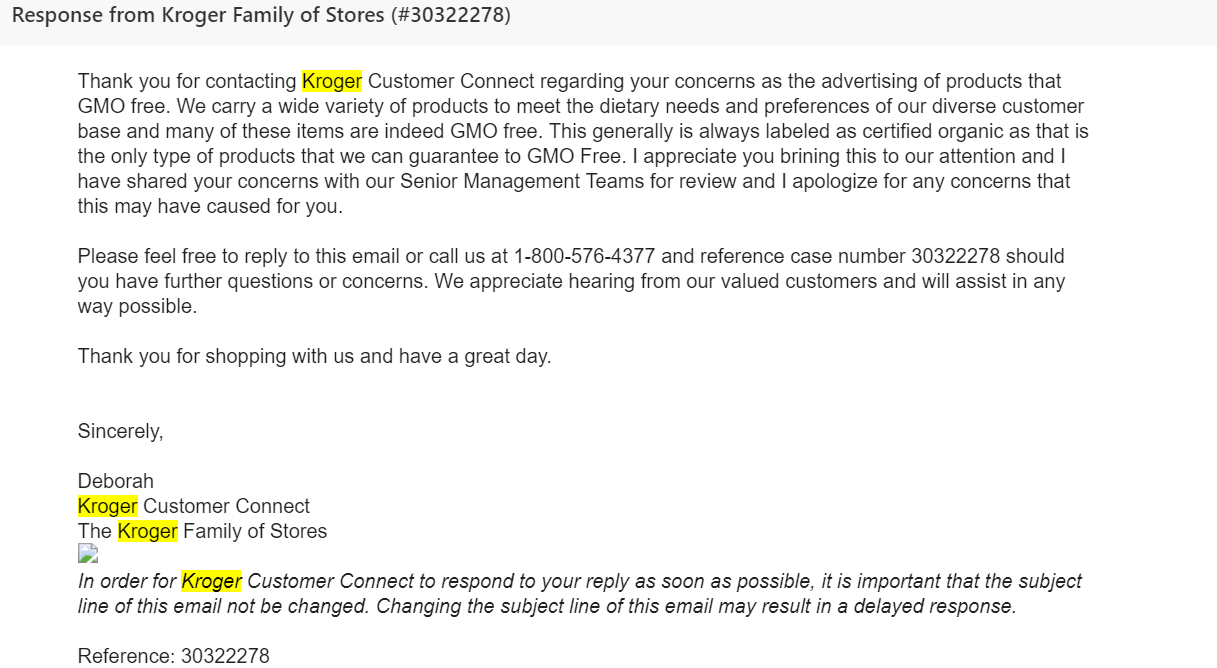
I wrote about how the advertisement made me feel and received a reply that showed that Kroger both did not read my comment but also apologized for my confusion rather than address their deceptiveness. Their response is Figure 1 found below. Several response emails were redirected with claims that my concerns would be forwarded to marketing and I couldn’t help notice that Kroger was perfectly content to explain how their food was non-GMO initially before they took time to understand my complaint. But once they were aware of everything the evasiveness grew.
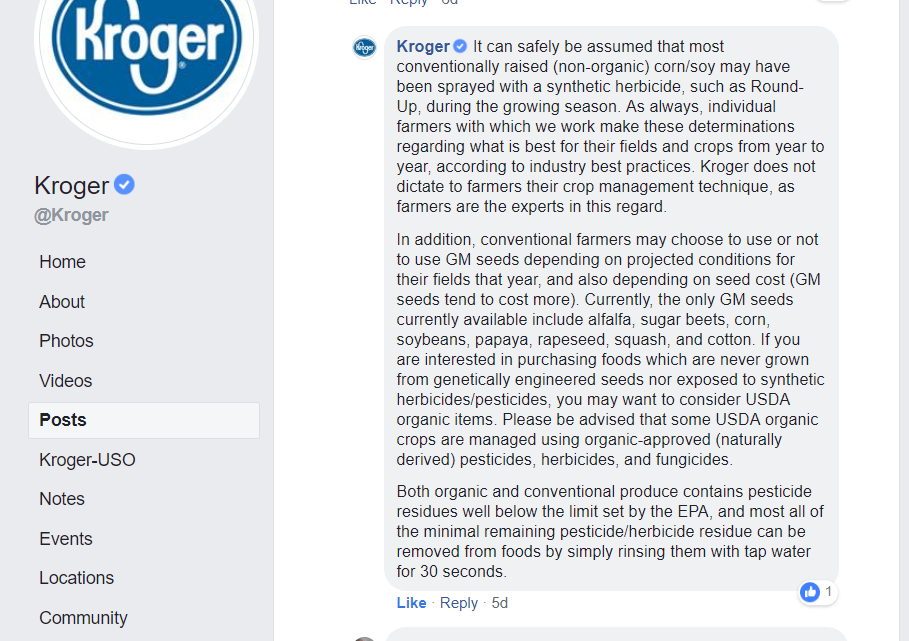
Eventually I received a direct response and explanation (Figure 2 below). While I appreciated an actual response I still feel that Kroger is both disingenuous that they have no knowledge of food systems and farming and are merely responding to consumer requests. The advertisements clearly show they are pushing consumers in a particular direction both with their tone, phrasing and the pronounceable ingredient comment in ad 2. However, I also have hope that they will respond. While Kroger was avoiding my emails I looked through their social media and found a brilliant response where an employee took the time to thoroughly explain pesticides, organic pesticides and more to a customer that appeared to not be aware (Figure 3 below).
So if you are a science teacher, an environmentalist or someone who’s just tired of having the dumbest possible labeling shoved in your face everytime you walk into a grocery store, please consider sending Kroger a message letting them know you would like to see more pro-GMO marketing, more educational labeling and fewer chemophobic messages. If you'd like to learn more about GMOs here are some helpful links. Ingredients in a banana can be found here. If you can pronounce it you should eat it meme.
Figure 1: Initial email response from Kroger after my complaint that their advertisements promoted anti-science

Figure 2: Email response from Kroger after I asked for a medical condition that would be positively impacted by a non-GMO diet