Showing posts with label teachers. Show all posts

Sunday, June 21, 2020

Some of my favorite books on antiracism

The first book I’m choosing is How To Be An Antiracist by Ibram Kendi. The reason I’m choosing it is because too few people have spent time constructing a productive definition of racism. Many know extreme examples of bigotry as racism, but struggle when things becomes more grey. Kendi defines racism by an action that has a negative impact on a race or because of race.
This may even seem silly to many of you. This would mean that a disease could be racist, or that a well-intentioned comment could be racist. But this allows us to evaluate the impact of our actions in a meaningful manner. Without this definition it becomes very easy to avoid making important changes. For instance, I hear a lot in schools that when we teach good lessons that all students will learn. But this allows teachers to avoid confronting what they are currently doing that causes Black students to do worse in school.
You can read Kendi’s work at The Atlantic (24.99 for a teacher’s subscription!), and if you want a denser book he also wrote Stamped From the Beginning which is a historical text about the history of racism in America through the lens of racists, antiracists and assimilationists.
The second book I’m choosing is The Souls of Black Folk by W.E.B. Du Bois. The reason I’m choosing this book is because as people begin reading they will begin to feel more comfortable and will overestimate the progress we have made towards racial justice. Yet this book was written 117 years ago and expresses the same ideals then that we continue to fight today. And in those same fights happened 100 years before this book and 100 years before that.
We continue to fight and people to continue to fight back against antiracism. It is important to measure the progress and our current report card is not one to celebrate. Currently we have young Black people and white allies protesting peacefully while being attacked by police riots. Yet the narrative that propagates casts blame on those who seek justice while undermining their cause. Currently our schools are more segregated. Currently more Black people are unemployed. It takes 11.5 Black households to add up to the wealth of the median white household. When Black children are taught poorly in schools we look to children to determine to find solutions.
So an important lesson to keep in mind as you start reading books is that this is not new, it is just new to you. The philosophies of Booker T. Washington, W.E.B. Du Bois, and Frederick Douglass all continue in similar forms today. If you have this book and are a teacher, page 72 is my favorite. Much of the book uses language that’s over my head, but that page I had a strong connection to.
The third book I’m choosing is We Want To Do More Than Survive by Bettina Love.
"When you understand how hard it is to fight for ed. justice, you know that there are no shortcuts and no gimmicks; you know this to be true deep in your soul, which brings both frustration and determination.”
This was a highly motivating book to read. Teachers know that too often students get to a point where the expectations shift to just surviving. Just turning in work, just attending, just staying awake in class, just doing an extra assignment. And these low expectations reach Black students more frequently. Bettina outlines her own personal experiences as a basketball star and helps teachers understand both how difficult it is to help students thrive as well as practical steps to be successful. Of all of the books I read this year, this was the one I bought for my mom to read.
The fourth book I’m choosing is Whistling Vivaldi by Claude M. Steele. This is a book about stereotype threat which very few people know about even though you’ve likely experienced it. Stereotype threat is when performance is diminished due to a negative stereotype threat about your identity that exists. For me as a white male this can easily be accomplished in sports and can also be done in academics. If I take a math test in a room of Asian students and attention is drawn to my race beforehand I will score worse on the test because my cognitive load will be partially occupied by the stereotype that Asian people are better at math.
The title of the book is from Claude’s childhood when he would whistle The Four Seasons by Vivaldi whenever he walked alone so that white people would not feel threatened by him. The book is about the various experiments about stereotype threat, how the experiment was conducted, and what the results were. The methods used are creative and enlightening, in particular for teachers. There is a section about a University of Texas professor who did research on helping Black students do better in calculus and reported intense gains in student achievement. A lot of the book otherwise focuses on the problem of stereotype threat, but the solutions are not always evident or simple. In the current book I’m reading they talk about how growth mindset works in opposition to stereotype threat and how to effectively help students have a growth mindset (it’s not by putting up a poster).
This is a book teachers should read. Stereotype threat is complicated and it should be an annual professional development session. But as far as I know I have never seen it offered in 15 years of teaching. If you read this book please let me know because I want someone to talk about it with.
The fifth book I’m choosing is The Color of Law by Richard Rothstein. The reason I’m choosing this book is because this was one of the first books that really changed my perspective. As a white person something that wasn’t explicit but was in my head was how I would act if I were Black. This book was really helpful to expose me to the fact that no matter what you do you’re going to fight an uphill battle that you are likely to lose regardless of the choices you make. It wouldn't matter if I did everything right. So many Black people worked so hard, accomplished so much, and then lost everything to white mob violence. The concrete examples helped me understand some, although I continue to feel the same disconnect at times when I listen to Black people talk about their experiences.
If you do not know what redlining was then you should read this book. If you know what redlining is but do not know of anyone that was negatively impacted by it, you should read this book. If you've never heard of Black Bottom, Black Wall Street, the MOVE bombing, etc. you should read this book. I have a copy if anyone wants to borrow it.
The 6th book I’m choosing is Making Black Scientists by Marybeth Gasman and Thai-Huy Nguyen. I had read a lot of books prior to this one in search of how to teach Black students better and I felt pretty stupid by about the second chapter. The premise of this book is that teachers search far and wide to improve their teaching of Black students but never actually go to the source of people who are the most successful at doing so. This book profiles HBCUs, what their staffs do, what their students do, and their philosophies. They also show how HBCUs are far more successful than Primarily White Institutions (PWIs).
An overall theme that emerges is that HBCUs focus on the student first. I know a lot of teachers think they do that, I’m sure our district would say we do that, but we value our systems first. It was enlightening to read what HBCUs do and they are a great measuring tool for teachers to push themselves. This is an extremely informative book that can really help you with how to teach better. I know teachers ask for a checklist sometimes and that just doesn’t exist. It takes hard work to teach better, but this book will help you do that.

The 7th book I’m choosing is Americanah by Chimamanda Ngozie Adichie. As my lunch friends can attest to, I’m not the best at reading fiction. But the narrative in this book is powerful enough that even I can take away a lot.
Ifemelu is the main character and she leaves Nigeria to study in the US at Princeton. She starts to blog about her first experiences with racism. In Nigeria she was just a person, but in the US she experiences being a Black person for the first time.
I also read The Purple Hibiscus and will likely read the rest of Adichie’s books in the next couple of years. If you’ve never seen her talk about the Dangers of a Single Story it is an amazing counter message to the in group/out group world that we live in.

The 8th book I’m choosing is Multiplication is For White People by Lisa Delpit. I’ve actually read Other People’s Children more recently and both are wonderful.
Lisa’s books are a strong combination of a mother’s voice both in her role as a mother and a teacher. But she gracefully mixes in facts to learn with personal anecdotes to supplement. Her balance of personal information as a teacher, parent, and expert on antiracism is highly motivating to read. This is a good book to read in August right before school starts. It’s also helpful if you feel motivated to do better but aren’t sure how to do so.
The 9th book I’m choosing is The Other Side of the River by Alex Kotlowitz. This is the story of an unsolved murder of a Black child that happened between St. Joseph and Benton Harbor, MI.
The mystery is the backdrop to the book, but the focus that emerges is the hostility, history, and healing between the two towns. I think this is something we all deal with. The surrounding areas that people look down on with little knowledge of those places. I know in Plymouth-Canton it is common to hear disparaging comments about Wayne or Westland. Downriver is pretty much one big chain of it. This is a natural tendency to form groups and have in-group and out-group dynamics. It is a toxic tendency.
One of the stories that I remember from the book was that teenagers from St. Joseph would do an activity called bricking. They would drive around and throw bricks at people in Benton Harbor. If you missed then you had to retrieve the brick. I’ll never stop thinking about that and how it encapsulates the dehumanization based on groupings. I saw similar ideals in the documentary America to Me, my high school experience, my teaching experience, and typical social conversation.

The 10th book I’m choosing is Timestamp by Marcus Granderson. Marcus was a student at PCEP who wrote a book that describes his transitions as he moved from a primarily white suburban school to Harvard to his work in New York City.
Marcus was generous enough to come talk to our teachers about his experiences. I didn’t have him as a student but I knew him slightly through a few others who did. I was also lucky to get to see his graduation speech years ago. His voice is one that will be sought out as teachers are looking for what they should be doing differently. This book details the moments he found impactful and how he perceived those moments. Unlike some of the other books that I’ve posted, this one is quite short if you’re not into long nonfiction reads. I have a copy in my classroom if anyone wants to borrow it, but you’re also welcome to support one of our recent graduates by buying a new copy! A few of us took him out to lunch after his speech and he's a lovely individual.

The 11th book I’m choosing I just finished yesterday and is Culturally Responsive Teaching And The Brain. To me cognitive science is a critical piece of antiracism because without it people are too quick to assign racism as a character trait which prevents them from meaningful change. Instead people should work to understand racist actions using system 1 and system 2 thinking so they can be pragmatic.
This book is the follow up to that learning. It has a lot in it so this is just the tip of the iceberg here. The start works to undermine misconceptions about using culture in learning. Using culture doesn’t mean putting up a poster, wearing a style of clothes, or eating a certain type of food. Culture is about language and communication. Culture is about being able to present information so that students can make connections to that information.
This book also walks through how teachers fail to teach students how to think critically. It goes through what we do, why some students get it, and how to change so that more students are taught better. Learning involves sensory memory being activated, short term memory processing, encoding into long term memory and retrieval. Hammond labels these as ignite, chunk, chew, and review. Igniting and chewing are the two spots where most students get left behind. A large number of solutions are presented for both.

Some other books that I didn’t post but are worthwhile:
Factfulness by Hans Rosling - This book is great for learning about how your perception of the world is wrong and how to change your perception to one based on facts and evidence.

The New Jim Crow by Michelle Alexander - I’m reading this one currently and the personal stories and statistics are gut wrenching. The thing I keep thinking about with this one is how when we watch a white character on tv (like Ryan from The Office) that it’s funny when they do illegal drugs. Yet in real life people’s lives are ruined because of harsh, inconsistent, and racist policies/enforcement. 

The Blood of Emmett Till by Timothy B. Tyson - This one is really odd for me to read because the murderer has the same last name as me. It’s a gross book, but something that’s problematic with many of these books is that it’s easy to see the statistics and get overwhelmed, but here they focus on a single person. And all of those statistics are the same thing. A life ruined, a family destroyed. 

Thinking Fast and Slow by Daniel Kahneman - There is a cognitive piece to racism that too few people understand. When using a brain based system 1 and system 2 model it becomes very easy to understand how racist actions happen and how to correct them. Teachers should be teaching their students about the experimental evidence in this book. 

Behave by Robert Sapolsky - This is what happens in your body and your brain before you do something. This was Thinking Fast and Slow but with twice as much in it. This book is long, but every chapter was intensely fascinating. The evidence provided is perfect for teachers to learn about how they perpetuate racism and what they can do to stop. 

Every Day Antiracism a collection of essays edited by Mica Pollock - This is a good book to read in a group. Too often people think about abstract ideas of antiracism without enough concrete examples. Concrete examples cause many to become uncomfortable and withdrawn. This book allows you to discuss concrete examples with other teachers so you can practice and learn.

Stamped From the Beginning by Ibram Kendi - This book is amazing, but it is a history text. It's a difficult read. The first and last chapters are the best where Kendi frames racism, antiracism, and neutrality in a historical context as racists, antiracists and assimilationists. If you don't want the full history, his book How To Be An Antiracist has those writings in a much lighter read.

The Dawn of Detroit by Tiya Miles - This book was a bit too complicated for me to understand easily. Somewhat similar to Stamped From the Beginning, but this book focuses on slavery in Michigan where I live. A large portion of the enslaved were Native Americans and the names of those slave owners linger today (Macomb, Woodward, etc.).

Sunday, January 26, 2020

Academic Honesty Council

Many years ago I used to grade while students took a test. But over the past few years I had to stop doing so because the only effective method of preventing cheating has been to watch students test for the majority of the exam. If students use watches, phones, their neighbor’s paper, or any other means I can tell when I watch them. It is a tiring game of cat and mouse and I dislike it very much. One thing that has worn on me recently as a teacher is the mounting pressures for students to find a way to get admitted into a University. That pressure is often an unhealthy one that stems from a variety of sources. And that pressure translates to the teacher. It becomes our job to be perfect, and sometimes better than perfect, or else did we really truly care about the student? If we let them down, we are a bad teacher and a bad person. 

If I didn’t say something often enough, or if I didn’t round a grade, or if I was absent too many times, or a million other things can all be the blame for why a student didn’t get a grade that’s going to keep them out of the college of their dreams. This hyperbole is infrequent relative to the number of students, but consistently present these days. And it’s exhausting. Along with that pressure on the teacher, there is another consequence. Students are being pushed to achieve these goals as a primary objective, not as a secondary. They aren’t trying to be good enough to get admission into a University, they are just trying to get the admission. This is a shame because I see too many students that are brilliant, but they get the idea that the only measure of importance is something that sometimes they end up discarding later in life. I’ve seen students stress so hard about going to the University of Michigan only to end up being admitted and choosing another path that worked better for them. This toxicity pervades the schools now. And it devalues learning and ethics. Cheating is a frequent result. 

Students cheat in a variety of forms. They seek out information about exams and quizzes. They do not consider this cheating, but rather strategic. They are taught that completion of assignments takes precedence over learning. They are taught that learning takes place outside of the classroom. So when they get to a test and struggle, it is easier for them to find a reason to cheat. I don’t have the solution to this problem. I’m against it, I will work against it, I wish more people would push back against it, but I don’t know that it can be eradicated. But we did something to share the burden on individual teachers and it is worth sharing. 

Academic Honesty Council
We formed an academic honesty council. When students are suspected or caught doing something that violates our terms of academic honesty they can be summoned to meet in front of a group of teachers. I was able to serve on our initial council. It was wonderful. The teacher who is directly involved was prohibited from the council. We took on part of their burden for them. When students cheat there is a mix of feelings for a teacher. There is a guilt that stems from the discussion above and there is also a feeling of hurt. On some level it is not possible to not take cheating personally. We put so much of ourselves into our teaching that when someone tries to circumvent the system it hurts. 

The council avoided both of these. It allowed us to examine what took place, listen to evidence, and have discussions with multiple teachers. From there we were able to work impartially to assign consequences that were fair, consistent and were productive. Because of the novelty of the council we had met previously with administration to seek advice on what to do in terms of enforcement, potential consequences, and seek general advice. This allowed us to work with students to learn from what happened and it avoided the isolation of being the only teacher involved. 

This can also help preserve the relationship between the teacher and student. A student caught cheating is having the investigation, verdict and punishment all coming from a teacher. And even teachers that try hard to be fair can be perceived as being inconsistent from a student’s perspective. Hard feelings toward that teacher can develop that can interfere with the student’s ability to learn in the future. 

The time that a teacher must dedicate to dealing with consequences is intensive. There are contacts to make, forms to fill, conferences to have and potentially even more. By having a council we absorbed some of that requirement. It allows the teacher to share the pertinent information that they have and the burden from there is split into multiple parties. 

Student Follow up

After our initial academic honesty council, we held a follow up meeting with the entire group of students in our cohort. Students shared a variety of thoughts that were noteworthy. Many felt resentment from their peers for cheating and sometimes just for being overly competitive. In my opinion, many students had diverging opinions on what is and isn’t cheating amongst themselves and relative to expectations of their teachers. Some students had honest questions about how teachers perceive cheating. Teaching can be overwhelming and sometimes it becomes necessary to seek out someone else to change things for the better. But I felt that this council as a good step in the right direction for a group of teachers to help improve things in a situation that could use more consistency and attention.

Saturday, January 25, 2020

Five Good Reasons To Go Into Teaching

When I ask students I am surprised at how thoroughly students would be able to explain to me why teaching was not an option for them. It is not a decision that they have made lightly. They know the projections of pay, the direction of legislation and the costs that they would need to input. But there are also good reasons to go into teaching that they are not aware of. 

Unsettled research
The access teachers have had to cognitive science research and how learning works has been limited until recently. As we continue to improve our understanding of learning, the research connecting that cognitive research to teaching is stuck. Teaching must be complex enough to cause permanent change in the brain structure. Teaching must also be simple enough to not overwhelm the short term memory capacity. Many teachers and researchers embrace one of those ideals but not both. Thus a large conflict prevents us from pushing education research ahead. That will change in the near future and you would be able to be a part of that. Other fields have research that is so advanced and settled. Our knowledge of medicine, economics, philosophy, science and mathematics are advanced to a point where the specifics are so advanced that they contribute little. But education has so much room for growth and improvement. Soon our abilities to teach and learn those other fields will be limited to how quickly we can educate people to the point where they can understand the new research needs of them. 

Autonomy 
The most important factors in a career is not money. Study after study shows that having autonomy in your job is one of the biggest keys to being happy and feeling impactful. Next week I will be teaching about chemical reactions. The number of approaches and methods that I could use to do that is unlimited. I have so much control over what I choose to do. I can experiment and try something new. I can take ideas from other teachers. I can do what I did last time with minor changes. On Tuesday I will be doing a new lesson that I got the idea from a book that I am currently reading. At any given moment when inspiration hits I am able to put that idea into action. What other job has that at this level? 

Ability to learn with an audience to keep you accountable
There was a reading teacher next door to me who would put up posters where she would put the book covers of books she read. I started to do so and quickly found myself reading more and more books. I am currently reading my 54th book this year and I love it. But being a teacher is a huge reason why I love it. I get to share what I read and learn with my students. If I read an interesting book about rust, I am able to use that in a lesson with my class. Everything that I learn about I have an audience to reinforce my own learning as I share it. I’m not convinced that if I went into work and was restricted from sharing my learning that it would not carry the same meaning to me. Whether the topic is history, chemistry, geography, environmental science, cognition or something else; I can always connect those topics to my teaching. It enhances my teaching. 

The most difficult job
Teaching is the most difficult job that exists. The sheer volume of decisions that teachers make during a lesson is enormous. No matter how well you teach something there is always a way to improve your lesson because there are so many different options you have. Having the ability to deal with managing children in a way that optimizes their learning involves decisions about their cognition, their prior knowledge, their emotional health, the physical arrangement of the room and the lesson medium. Because of the overwhelming number of students (150-250) you must have plans for an incredible number of disruptions and adjustments to make. You have to introduce a new idea in a way that maximizes learning, provide practice that maximizes learning and give assessments that measure the learning that took place. All of that must be done to a large group of students with wildly different experiences and prior knowledge. Whether the goal is to maximize learning or to maximize homogeneity in knowledge is inconsistent depending on the objective, course and content piece. Behind all of these pieces is the content itself. I must understand all of the chemistry I am presenting which includes all of the chemistry that students perceive. I must understand and be prepared to respond to every conception that a student brings to the classroom along with what evidence and theory can advance those conceptions to better models. It is an unending journey towards a perfection that doesn’t exist even in theory. No other profession comes close to the combination of skills needed to maximize success. And that challenge is welcome. Teachers seek challenge. They want to be pushed to the limits of human ability. 

Online networks

When I was in high school teachers were isolated. They would seek community in lounges, but the atmosphere was potentially toxic. With social media teachers are able to connect with other teachers. We have access to the best of the best and can use each other to further our own abilities. The sharing and cooperation that results from social media has opened new doors to teachers from mentorship opportunities, to highlighting creativity, to challenging our own conceptions and ideas about teaching. These networks incentivize teachers to push beyond the typical boundaries of teaching that have existed in the past. Teachers can share improved models, dual coding and concrete examples for content. Teachers can share research, new pedagogy and more advanced curriculum. Teachers can learn from others about organization, technology, and creativity in lessons.

Thursday, July 25, 2019

ChemEd 2019

I just returned from ChemEd 2019 and I could not be happier. I had a four hour drive to think about the conference and about teaching. The complexity involved in teaching is overwhelming at times. But as I improve in teaching the complexity becomes such a joy and conferences are a huge source of that emotion. Being around some of the best chemistry teachers in the world is so intellectually stimulating to me.
Teaching is complicated. You have to understand some information, deliver that information to a novice learner and work towards their brain changing in a meaningful manner. Their brains will filter much of that information and that which does arrive successfully runs the risk of becoming forgotten. Racism, sexism and other power structures can affect both the delivery and reception of that information. Emotion and the amygdala can also interfere. Between the cognitive science and the sociology there lies chemistry. Chemistry is a beautiful subject to teach, but it is also incredibly complex. So teaching is the intersection of all of these things. A teacher has to be able to account for all of them with a collection of students that vary considerably in their initial understandings and knowledge that they can use to make new connections. There is no limit to how far you can push your cognitive limits as a teacher.
So I feel that as my preparation and experience improves, I am getting to a point where I can effectively navigate all of these. But it’s hard. And the many cycles of preparation, teaching and reflection are needed to become masterful at teaching. The ChemEd 2019 conference had so many teachers that were brilliant. To just watch them teach us was amazing. It felt like the concept from the book “Inner Game of Tennis.” My system 1 was just learning without my conscious mind interfering. But in addition to the teaching technique, there was also an abundance of creativity. An artistry or uniqueness that I loved watching and dissecting. 
My favorite part of teaching is this vast combination of cognitively demanding tasks that all require improvement. I think that teaching is the ultimate cognitively demanding profession and we talk about this too infrequently. I appreciate the sheer difficulty of doing this well and so I am incredibly happy when I get to observe someone doing this at such a high level. I find it so impressive when someone can combine so many tasks but also add in creativity. Being able to reflect and critique things afterwards with a group of teachers is the best. I also feel that the presentations have changed in the last few years. The level of elite teaching has stretched so high and I wonder if it would be fruitful to consider intentionally pushing for a localized arrangement of elite teachers to see what could be accomplished. I wonder what we could do if we intentionally arranged a cohort of teachers and gave them a working environment that was modeled after a conference like this. 
Sometimes when we teach we repeat things so frequently that complicated concepts become algorithmic and automatic. Some refer to this as saying I learn the best by teaching. But as we shift teaching into responding towards initial student models the cognitive demand becomes so much higher on teachers. It’s not just a transfer to long term memory of phrasing or algorithms. It is that deep thinking that is challenging and rewarding. And that means that the intellectual stimulation also rises with it. And I love it. I know that many avoid recommending the teaching profession, but I can’t think of a better job. There is nothing that I could do that push my thinking more than teaching does. And some of the new educational pedagogy provides such an opportunity to push yourself in ways that have not existed before. To me, the conference felt like I was surrounded by people who derived the same joy that I felt. I hope to be back at one soon.

Sunday, January 14, 2018

The Staff Meeting I Dread - Student Course Selections


A few years ago I had a student take the advanced chemistry class I was teaching.  They did not do well on the first few exams we took and eventually I checked over how they had done in chemistry.  Lo and behold their grade was quite low.  Now when I recruit for IB chemistry or AP chemistry I make it a point to tell the students first that if they did not do well in chemistry that they should take AP chemistry or IB chemistry.  Why go to college and struggle through the material alone when you can work through it with a high school teacher that is likely to be far superior at teaching and where you will move much slower through the material with a lot more assistance?  When I lead with this I often hear a few students laugh as I start the comment before quickly realizing the validity of my perspective.   
So you would think that the first thing that I would have done would have been to talk to the student about their struggles and their ambitions and goals of taking the class.  But this year I had an overwhelming amount of struggle going on from my students and myself teaching new classes.  So instead I deflected and would just get frustrated every time I had to grade another round of tests that had a demoralizing amount of wrong answers.  Then at the end of the year I was talking to the student about college plans.

Me “What are you doing next year for school?”
Students “I’m not sure”
Me “Do you want some advice”
Student “Yeah, well the thing is, I just really love chemistry so much.  It’s my favorite subject, but I’m so bad at it.  I want to major in it, but I don’t know what to do.”

Had my frustrations with their lack of success influenced how I taught this student?  If I had had a better perspective would that student not have those doubts?  I could have taught them better than I did but now they got to carry all of the weight of my decisions.  I was really disappointed in myself because even though I tell students that struggling students should take these classes I had never considered that a student could struggle and love the course.  What had happened to my idealism?  I love chemistry and I don’t love it because of how well I can do problems in it.  I love taking the best results and conclusions from the smartest people throughout history.  I love connecting the macroscopic level with models in the microscopic level so that students can understand what is happening.  Teaching and learning chemistry is my passion and I had missed a chance to share that with someone seeking just that.  
Every year there will be a staff meeting for our department where we talk about scheduling.  I dread this meeting.  Teachers somehow are systemically driven to develop philosophies that only student X belongs in a class and students that do not accomplish Y prior to the class are failures unworthy of learning that content.  There is an angry tone in this conversation and in my view it is because the conversation is unhealthy.  This meeting makes me feel like I've been trapped in the Stanford Prison Experiment and am stuck being a guard. We go to great lengths to prevent students from taking a variety of classes from AP courses to honors courses to regular chemistry.  I wish this were an isolated thing, but I am quite confident that it is systemic because I see it frequently on social media, at conferences and from many teachers beyond my own district.  But I believe very strongly that this mentality of exclusion is damaging and worthy of resistance.  Students in our district are exposed to it every time they sign up for classes starting in 6th grade.  There is an unrelenting pressure put on them that they are not good enough to be where they are and the mental health toll is a disaster.  Think of a student that has been told every year that if they are not at a level of success that they should not be learning about chemistry, or biology or trigonometry.  Now envision what happens if that student struggles in a unit.  Even if they had been successful in everything they had done to that point, any struggle signals to the student that they do not belong in that class.  The conversations we have about course selection likely make children unhealthy in how they learn and I believe also promote segregation based on race and gender.  
We need to stop leading students to evaluate what they should do based on their grades and external mechanisms.  Many would argue that grades are essential to this discussion, but we are talking about 11 year olds.  We are talking about 14 year olds.  How a 14 year old does should have no bearing on whether they can learn chemistry as a 15 year old.  And often the evaluations we do don’t even make sense.  Math skills are not essential to high school chemistry.  High school chemistry uses multiplication and adding.  Students that struggle with manipulations in chemistry class struggle because they do not understand the chemistry involved in the manipulations.  Biology success should have no bearing on how a student does in chemistry.  There are millions of people that were more successful than I was in biology both in high school and in college but only a handful of times have I felt out of place in chemistry or physics.  These perspectives are common and counter productive.  Teachers of struggling students resort to them because of being overwhelmed by the difficulty of teaching.  If a student is struggling with something we should be able to give them specific feedback, have the student improve and continue that cycle throughout the year.  Instead we give students overly simplistic directives to avoid having the conversations we aren’t prepared for.  Work harder, study more, read the text more, etc.  
Students, teachers, parents, counselors and administrators all contribute to the reduction of course selection.  And perhaps all of us suffer the consequences of this as well.  Counselors and administration often use course selection as a means to avoid dealing with problems in classes.  If a class is taught using extreme methods that are exclusive, we help that teacher exclude students rather than address the teaching methods.  This can cause parents to seek exclusivity as a sign of elite status rather than focusing on student achievement.  This can allow negative teacher perceptions to fester.  So let’s break this habit.  If you’re a student don’t allow yourself and your fellow students to be marginalized by course selection presentations.  Ask your teachers thoughtful questions and seek out their passion.  Do the same with counselors.  We all love what we do and chose our profession out of passion.  Help us find our spark again.  Guide us into talking about the best parts of classes rather than the worst so you can walk into a class confident you will learn valuable things rather than being nervous about grading policies.  At some point in your life, no one will care what grades you got at all.  For many of us, that is when we are 17 years old.  So let’s spend less effort maximizing our GPA for little to no benefit and more effort learning about the best accomplishments of humanity.  

Friday, September 29, 2017

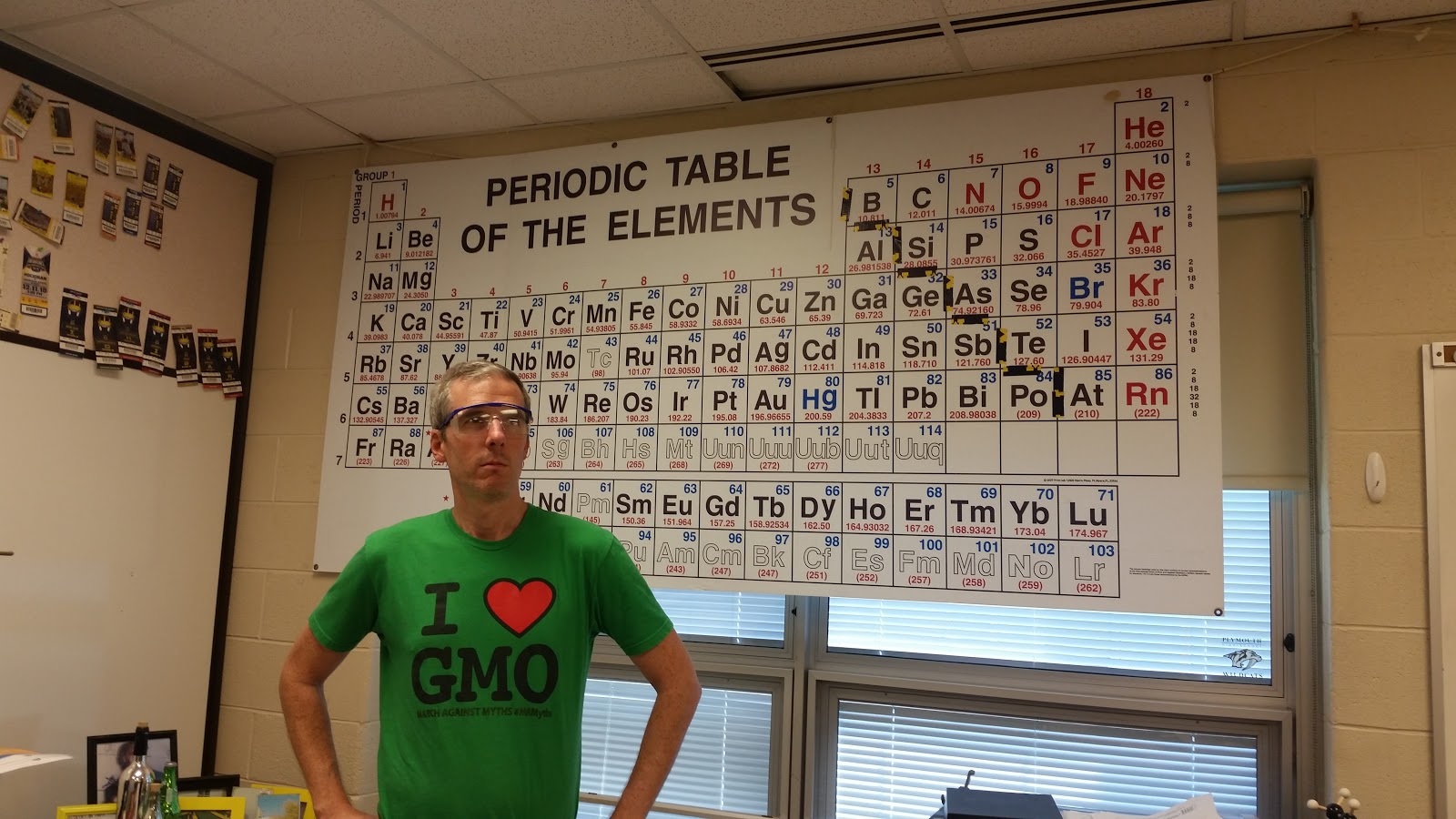
Teach Students the Positive Impacts of GMOs

Scientists often have difficulty communicating their research to the public and false marketing has filled that gap for some time with regards to nutrition and food production.  Meaningless and deceptive labeling have been used and misconceptions have developed.  Social media has exacerbated the disconnect between public perception and reality with regards to nutrition and food production and there are consequences to this distortion.  This gap exists for many well intentioned people and teachers might be the key to bridging the gap.   Public opinion has begun to reverse this trend in topics such as climate change and vaccines but agriculture and food lag behind.  It would surprise many to find that there is greater agreement on the safety of genetic modification of food than there is on climate change.  Many would assume that this ignorance is of minor consequence.  They would be wrong.  As the world population has increased and poverty levels diminish farmers have quietly gone about their business.  Most are unaware that over the past twenty years farming has had very little increase in farming acreage despite farmers feeding many more people due to population growth and reduction in starvation.  
The benefits of using genetic modification with regards to food are diverse and impactful.  The environmental impacts alone are huge and include a reduction in carbon dioxide emissions, less pesticide use, safer pesticides5 and the potential for reductions in animal cruelty6.  Genetic modification has the potential to allow those allergic to peanuts to eat peanuts safely, those with Celiacs disease to eat bread and vegetarians to eat the Impossible Burger © that cooks and tastes like meat due to genetically engineered yeast that produces hemoglobin.  The healthiness of produce that is organic, genetically modified or non-GMO are similar but typically most healthy for the genetically modified versions.  Foods with non-GMO labels often lack vitamins in order to meet the criteria for labeling.  Organic food and traditional agriculture are similar in health benefits but for many the price of organic food would cause the consumer to purchase fewer fruits and vegetables that are one of the most critical components of a healthy diet.  
Scientific evidence can be drowned out by loud voices.  Posting or sharing an article with an exaggerated headline is much more common than one that is scientifically sound.  Many people have heard false information for so long that they are unwilling to believe evidence and will dismiss experts as shills.  These people still influence the supply of food distributors and producers by being organized and frequent communication.  But it is time for the evidence and truth to trump fear-mongering.  Teachers are in a key position to do this.  We have an audience and we are tasked with educating that audience about using evidence, critical thinking and evaluating sources.  Science teachers of all fields can find connections to the environmental impact and potential for genetic modification.  Teach your students about the different methods of genetic modification and point out the absurdity of transgenics being singled out in spite of no evidence of safety differentiation between other genetic modification methods.8    Teach your students about the historical methods of food production and some of the amazing things we do today that improve our lives.  Teach them that the non-GMO movement was one of deception and marketing and that scientific evidence continues to struggle against fear of consumers.  Play an NPR interview with farmers and have them write about whether farmers should cave to financial pressure or do what is best for the planet.  If you want to have a discussion on capitalism and economics make sure to discuss the organic industry and its lobbying efforts along with their deceptive marketing to make money off of the vulnerable (or that purchasing non-GMO leads to an increase in slavery).  Even if you do not teach science you can still make a large impact on your students and your community.  
20170921_125546.jpg

Resources for science teachers that I have found helpful:
9.  Video about GMOs for students
10.  Food Evolution narrated by Neil DeGrasse Tyson

Twitter accounts to follow

Please add suggestions for good resources in the comments below too.

Thanks!