Showing posts with label NGSX. Show all posts

Friday, September 29, 2017

Teach Students the Positive Impacts of GMOs

Scientists often have difficulty communicating their research to the public and false marketing has filled that gap for some time with regards to nutrition and food production.  Meaningless and deceptive labeling have been used and misconceptions have developed.  Social media has exacerbated the disconnect between public perception and reality with regards to nutrition and food production and there are consequences to this distortion.  This gap exists for many well intentioned people and teachers might be the key to bridging the gap.   Public opinion has begun to reverse this trend in topics such as climate change and vaccines but agriculture and food lag behind.  It would surprise many to find that there is greater agreement on the safety of genetic modification of food than there is on climate change.  Many would assume that this ignorance is of minor consequence.  They would be wrong.  As the world population has increased and poverty levels diminish farmers have quietly gone about their business.  Most are unaware that over the past twenty years farming has had very little increase in farming acreage despite farmers feeding many more people due to population growth and reduction in starvation.  
The benefits of using genetic modification with regards to food are diverse and impactful.  The environmental impacts alone are huge and include a reduction in carbon dioxide emissions, less pesticide use, safer pesticides5 and the potential for reductions in animal cruelty6.  Genetic modification has the potential to allow those allergic to peanuts to eat peanuts safely, those with Celiacs disease to eat bread and vegetarians to eat the Impossible Burger © that cooks and tastes like meat due to genetically engineered yeast that produces hemoglobin.  The healthiness of produce that is organic, genetically modified or non-GMO are similar but typically most healthy for the genetically modified versions.  Foods with non-GMO labels often lack vitamins in order to meet the criteria for labeling.  Organic food and traditional agriculture are similar in health benefits but for many the price of organic food would cause the consumer to purchase fewer fruits and vegetables that are one of the most critical components of a healthy diet.  
Scientific evidence can be drowned out by loud voices.  Posting or sharing an article with an exaggerated headline is much more common than one that is scientifically sound.  Many people have heard false information for so long that they are unwilling to believe evidence and will dismiss experts as shills.  These people still influence the supply of food distributors and producers by being organized and frequent communication.  But it is time for the evidence and truth to trump fear-mongering.  Teachers are in a key position to do this.  We have an audience and we are tasked with educating that audience about using evidence, critical thinking and evaluating sources.  Science teachers of all fields can find connections to the environmental impact and potential for genetic modification.  Teach your students about the different methods of genetic modification and point out the absurdity of transgenics being singled out in spite of no evidence of safety differentiation between other genetic modification methods.8    Teach your students about the historical methods of food production and some of the amazing things we do today that improve our lives.  Teach them that the non-GMO movement was one of deception and marketing and that scientific evidence continues to struggle against fear of consumers.  Play an NPR interview with farmers and have them write about whether farmers should cave to financial pressure or do what is best for the planet.  If you want to have a discussion on capitalism and economics make sure to discuss the organic industry and its lobbying efforts along with their deceptive marketing to make money off of the vulnerable (or that purchasing non-GMO leads to an increase in slavery).  Even if you do not teach science you can still make a large impact on your students and your community.  
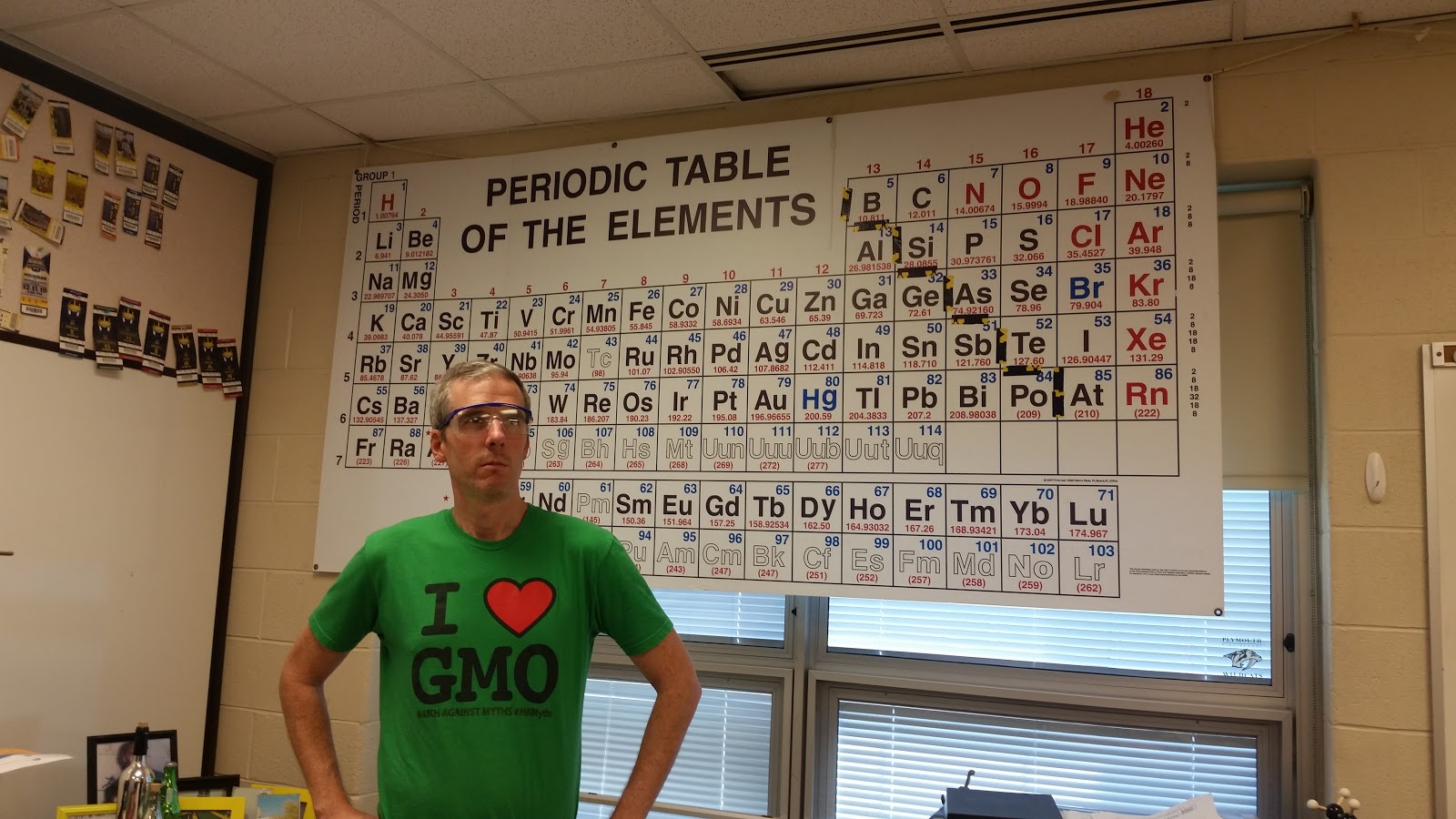
20170921_125546.jpg

Resources for science teachers that I have found helpful:
9.  Video about GMOs for students
10.  Food Evolution narrated by Neil DeGrasse Tyson

Twitter accounts to follow

Please add suggestions for good resources in the comments below too.

Thanks!

Wednesday, May 3, 2017

Teaching Energy With NGSS

The 2017 Flame Challenge presented the challenge of explaining what energy is and even within the best of the best explanations there is a hesitancy to actually define what energy is.  Energy is a challenging topic because it appears to be utilized differently across scientific fields.  I propose here that energy would be better off viewed with a consistent framework that limits energy use to one of convenience rather than its current inconsistent use.  


What Is Energy?
Energy is a mathematical shortcut to solving physics problems.  It is highly convenient to use because energy calculations can greatly simplify calculations for when force is variable or when there are a large number of particles.  Objects do not possess energy, rather we can describe them using an energy that we define.  A similar concept is momentum.  There is no such thing as momentum, it is a mathematical concept that allows us to simplify calculations involving collisions.  Momentum is convenient because you do not need to know all of the information about what happens in the middle of a collision.  Momentum is a math function that works because of how we defined it mathematically and the laws of motion in physics.  Energy is also a math function that works because of how we defined it mathematically and the laws of motion in physics.  
Our definition of energy is the integral of force over a displacement.  Depending on the type of force being opposed we come up with different equations which we call different forms of energy.  If we push an object and the force is unopposed this results in a change in velocity of the object.  The integral in this case produces the equation ½*mass*velocity2* which we call kinetic energy.  If we push an object against Earth’s gravitational field the integral produces the equation mass*gravity*height (mgh)**.  
So if we drop an object from a height of 9.8 m and we want to know how fast it is traveling just before contacting the ground we have two options.  We can use kinematics and determine how long it will take to reach the ground and then calculate what the velocity will be at this time.  We would use the kinematics equations below to accomplish this through some simple manipulations.  
vf = vi + at
pf = ½at2 + vit + pi
Our initial position is 9.8 m, final position is 0, initial velocity is 0 and thus the 2nd equation plugged in would be 0 = -4.9t2 + 9.8 where t = 2(0.5).  We can plus this time into the first equation to obtain the final velocity of -9.8*2(0.5) = -13.9 m/s.  
We can alternatively use the sum of initial potential and kinetic energies.  We can define the final height to be 0 and so initially our kinetic energy is 0, potential is mgh.  Our final situation has a kinetic energy of ½ mv2 and potential of 0.  If the total amount of energy is conserved we get
mgh = ½ mv2; which simplifies to v = (2gh)(0.5) = +/-13.9 m/s and since our downward direction was previously defined as negative we get a final velocity of -13.9 m/s.  The energy calculation produces the correct answer with simpler mathematics.  


*actual result is ½mvf2 - ½mvi2
** actual result is mg(hf-hi)

Guidelines for teachers

  1. Anything you can explain with energy can also be explained using force, position and motion.  If you cannot explain how something works without energy, you will probably not explain it well using energy.  Energy is a shortcut both in mathematics and justification of phenomena and so it is important to have a strong framework in place prior to utilizing energy as a means of convenience.  
  2. Energy is linked with force and motion.  Potential energies are all derived from an integration of a force over a displacement.  Therefore we should not be inventing energies that do not link directly with a force.  There is no “chemical force” and therefore using the term “chemical energy” is misleading.  There are electrical forces, nuclear forces, gravitational forces and we also have kinetic energy derived from an unopposed force that causes a change in motion.  Chemicals may be assigned an energy but it is electrical energy and kinetic energy, not chemical energy.  
  3. Heat is a transfer of energy and the mechanism of heat gets very cloudy when people present heat energy as a type of energy.  Heat energy is a means of describing the kinetic energy from molecular motion and would be better off either using kinetic energy or thermal energy as descriptions.  Thermal energy and heat energy have the same intent of definition but thermal energy is much easier to distinguish from heat.  This allows us to define heat as a transfer and not an energy allowing us to better emphasize the role of collisions and molecular motion during heat transfer.  
  4. There are situations where using motion, position and force would be overwhelming and thus energy is needed.  This is the case often in chemistry because of the sheer number of particles coupled with a lack of information about specific motion.  
  5. Some situations we do not currently have explanations for without energy.  This is because of the complexity of the situation and our inability to analyze them that limits our discussion to energy shortcuts.  For example, the motion of electrons in atoms is not possible to be viewed.  We cannot track an electron without disturbing how it moves.  Our information we get about electron motion comes mostly from interactions between the electron and light.  Thus it is needed for us to discuss this in terms of energy because the simplistic nature of energy allows us to have meaningful relationships developed even though we are unable to explain quantization in more accurate terms.  But this does not mean that the electron does not follow a set of rules beyond energy, rather that we are limited in our observations and explanations.  
  6. Light is not energy, fire is not energy, food is not energy.  Light can be assigned an energy value based on its frequency but we can also just explain that there is a connection between the initial vibration of the charged particle that produces the light and what the light will be able to do to the particle that absorbs it.  Instead of describing light as energy try linking light to the charged particle it comes from and the electric field disturbance caused by the acceleration of the charged particle.